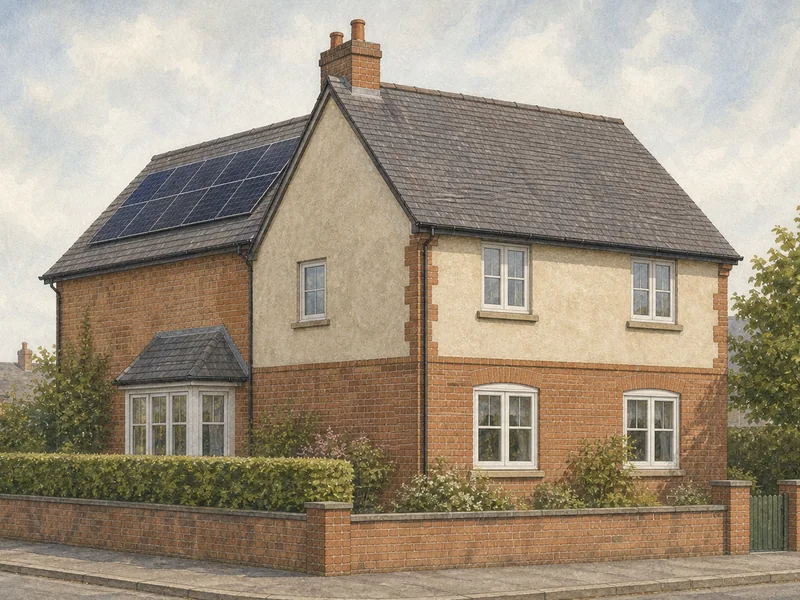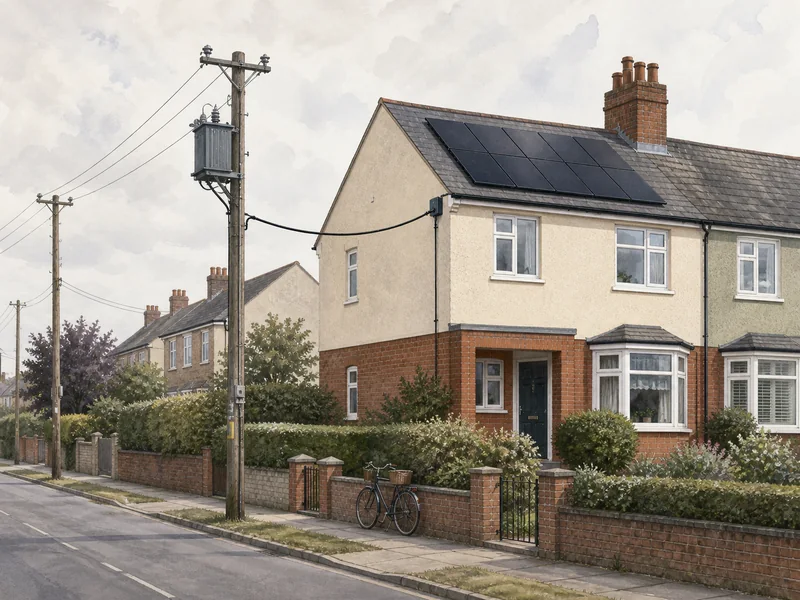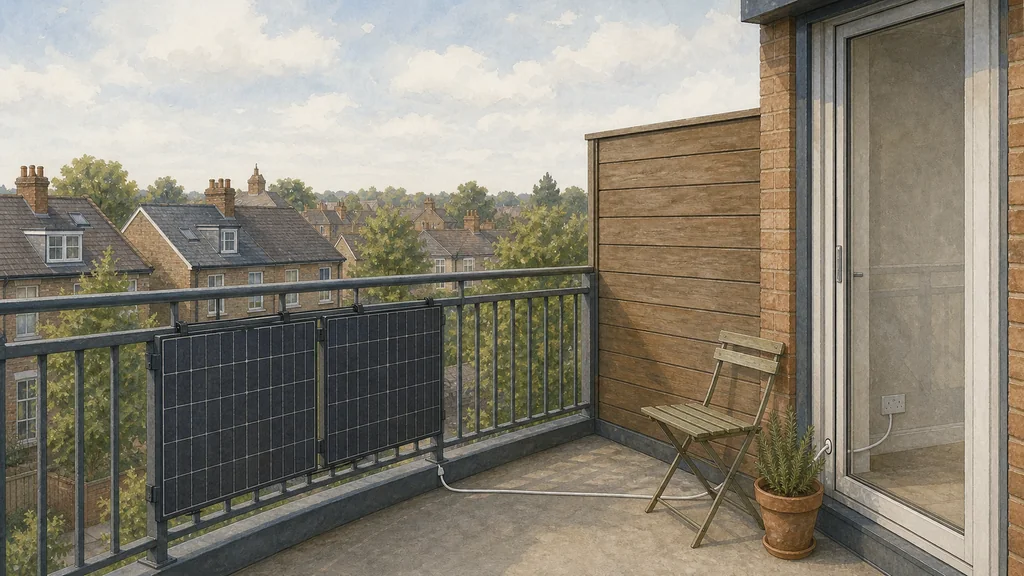
Plug-in solar means a panel or small array that connects to your home’s electricity through an ordinary plug and socket, rather than being wired in by an electrician. On a balcony, a flat roof, a fence, a garden wall.
Until 27 August 2026 it sat in an awkward gap: not obviously covered by the permitted development rules for solar, not obviously outside them. That gap has now closed, and the way it closed is not what most of the coverage says.
It has a definition now
The Town and Country Planning (General Permitted Development) (England) (Amendment) Order 2026 defines plug-in solar as “solar photovoltaics that are intended for connection to the relevant domestic premises’ electricity installation by means of a standard plug and socket”. “Standard plug” and “socket” take their meanings from the Plugs and Sockets etc. (Safety) Regulations 1994.
The Order then amends the existing definition of solar PV so that it reads “including plug-in solar”. That single edit is what brings the category inside the regime.
So the honest description of what happened is not that plug-in solar became legal. It is that plug-in solar became defined, and in the same instrument it became limited.
Source: The Town and Country Planning (General Permitted Development) (England) (Amendment) Order 2026, S.I. 2026/896, article 5, in force 27 August 2026. https://www.legislation.gov.uk/uksi/2026/896/made
The restrictions written specifically for it
Two exclusions in the Order exist only for plug-in solar, and both are about what you fix it to.
On the building. For a dwellinghouse, it is not permitted development where any part would be installed on a wooden wall, balcony or enclosure, or on any timber-clad part of the exterior (A.1(2)(h)). The same exclusion applies to blocks of flats (A.1(1)(f)).
In the garden. For a stand-alone installation, it is not permitted development on a wooden fence, gate, wall or other means of enclosure (B.1(2)(d)).
Read those together and a large share of the obvious mounting positions are ruled out. A timber balcony, a garden fence, a clad wall: these are exactly where the products in circulation are designed to hang, and exactly where the Order says permitted development does not apply.
And every other limit applies too
Because plug-in solar is now inside the definition of solar PV, it is not a special relaxed category. The whole of the rest of the regime applies to it.
That includes the protrusion limits: 0.2 metres beyond the plane of a wall or balcony or roof enclosure that abuts a highway, 0.4 metres elsewhere, 0.2 metres beyond a pitched roof slope and no higher than the ridge, 0.6 metres above a flat roof. It includes the exclusion, in a conservation area or World Heritage Site, on any wall, balcony or roof enclosure that fronts a highway. It includes the outright exclusions on listed buildings and scheduled monuments.
The full set, with the article reference for each, is in do you need planning permission for solar panels.
Planning is only half the question
This is the part that almost nothing else covers, and it is the part that decides whether a plug-in kit is a sensible purchase.
The Order deals with planning. It says when an installation is permitted development and when it needs an application. It says nothing about whether connecting a generator to your home through a plug and socket satisfies the wiring regulations, and nothing about your obligations to your distribution network operator.
Those are separate regimes with separate rules. Any generation connected to your home has to be notified to your network operator, and the route depends on its size. How that works is set out in G98, G99 and G100 explained.
We are not going to tell you the electrical position is fine, because we have not been able to verify it against a primary source, and we are not prepared to assert it from a supplier’s marketing page. What we will say plainly is this: clearing the planning hurdle does not tell you the installation is electrically compliant, and anyone selling you a kit on the basis that “the rules changed in August” is answering a different question to the one that matters.
If you are considering one, ask the seller which standard the unit is certified to, and what they say your notification obligation is. Then confirm that answer with your own network operator rather than taking it from the person selling the product.
Be careful what you read on this
Coverage of this Order has been poor, including from sources that ought to know better.
We have seen a 300 millimetre roof projection figure, a roof coverage percentage cap, and a 15 square metre ground array limit attributed to it. None of those appears anywhere in the Order. We have also seen the change dated to April 2026, and described repeatedly as making plug-in solar legal, when the instrument came into force on 27 August 2026 and its own Explanatory Note says it “introduces new limitations”.
Every figure on this page is taken from the operative text and carries its article and paragraph reference, so you can check each one yourself rather than take our word for it.
What we cannot tell you
Whether your specific property, balcony or fence is caught by any of the above depends on facts about your home that we cannot see: what it is made of, what it faces, and what designations apply to it. Your local planning authority is the authority on that, and asking them is free.
Nothing here is planning, legal or electrical advice. Eco Connect Services gives independent advice on renewable energy decisions. We do not install anything, and we do not sell plug-in solar.
Information correct as of 27 August 2026.