Solar owners check one number more than any other: self-consumption. A dashboard showing 95 or 100 percent self-consumption looks like the system is working exactly as it should. Sometimes it is. Sometimes the same number means the opposite: the system stopped generating hours ago and nobody noticed, because the app has no way to show energy that was never produced.
The difference matters, and it turns on one question most owners have never had to ask: can your system export, and if so, up to what limit?
The four export positions
Every solar and battery system connects to the grid under an agreement that sets whether, and how much, it can export. That agreement is usually one of these.
An unrestricted export connection, agreed with your network operator, commonly a G98 connection, with a Smart Export Guarantee contract in place with a licensed supplier who is required to pay for exported electricity. An unrestricted export agreement still runs over a standard G98 connection, which is itself capped at 3.68 kW export on a single phase, so a larger array can still reach that ceiling and curtail once the battery is full and demand is met.
A capped export connection, where the network operator has agreed a lower export limit than the system could otherwise produce, enforced by an export limitation device.
A zero-export connection, where no export is permitted at all and the system is required to hold generation at or below what the house is using at that moment.
No Smart Export Guarantee agreement in place, so exported electricity is technically possible but not currently being paid for.
Which one applies to you decides whether a full battery on a bright day is costing you money or costing you energy. Those are not the same problem, and the fix is not the same either.
When a full battery is not a problem
If your connection allows unrestricted export and you have a Smart Export Guarantee contract, a full battery on a sunny afternoon is not wasting anything. Once the battery has nothing left to store, the surplus goes to the grid and you are paid the export rate on your contract.
That is normally worth less than using the electricity yourself, because export rates tend to be lower than the rate you avoid paying by not importing, but it is not worth nothing. Every exported unit still earns something. Nothing here needs troubleshooting. It is the system behaving as designed.
When it is
This is the case that costs owners real generation without them realising it. Where export is capped or zero, the inverter is required to throttle output once it reaches that ceiling. It does this by holding the panels below their potential rather than letting them generate and then discarding the surplus.
That generation is never produced. It is not stored, not exported, not lost in transmission. It simply does not happen.
This is curtailment, and it only happens because the surplus has nowhere to go: no export headroom, no room left in the battery, and demand in the house already met. A capped or absent export agreement is what turns a full battery from a minor inconvenience into a genuine loss of energy.
The three signs, in numbers you already have
Curtailment leaves a signature in the numbers most monitoring apps already show, if you know what to look for.
The battery reaches full charge unusually early. If your battery is showing 100 percent by mid to late morning on a clear day, well before peak sun, it has finished its one job for the day, and everything that happens afterwards depends entirely on whether the system can export.
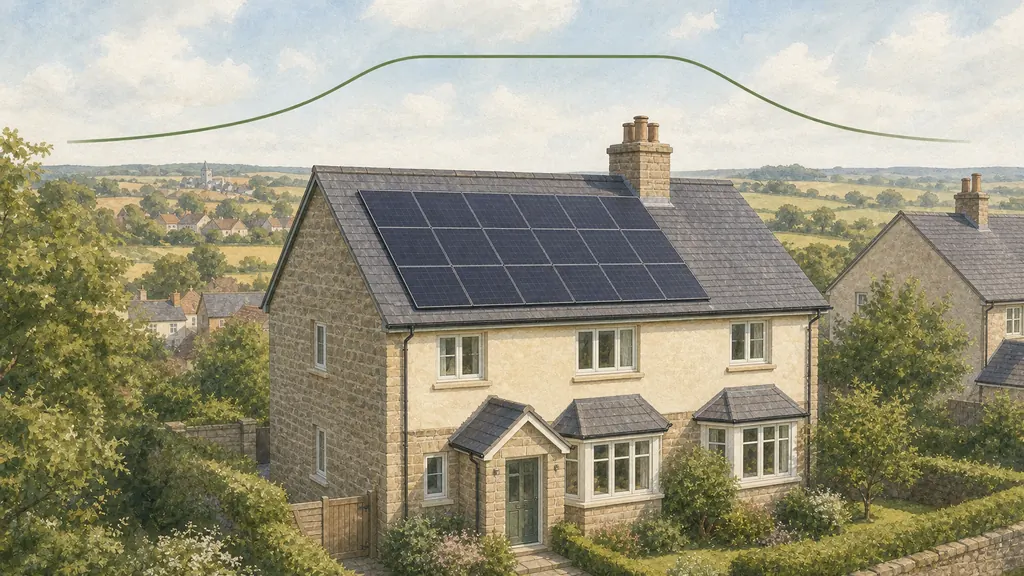
The generation curve has a flat top instead of a bell. A healthy solar day looks like a smooth curve that rises through the morning, peaks around midday and falls away in the afternoon. A curtailed day rises normally, then plateaus at a fixed level for hours through the brightest part of the day before falling away again. A flat top where the peak should be, because the inverter is holding output down.
Export sits at zero, or pinned at one figure, for hours on a bright day. If your app shows an export reading of exactly zero, or a single unmoving number, for a long stretch of clear weather, that is not the system choosing to hold back. It is the system being prevented from producing more than that figure.
Any one of these on its own is worth a second look. Together, on a day with no cloud cover to explain them, they point to a system that is throttled rather than a system that is simply efficient.
Why the headline figure hides it
Self-consumption measures what proportion of the electricity a system generated was used in the house rather than exported.
If the system has curtailed itself to avoid exceeding an export limit, the app can report a perfect self-consumption score while genuinely producing less than the panels were capable of that day. A high self-consumption figure on its own does not tell you whether generation was maximised. It only tells you what happened to the electricity that was actually produced.
If the checks here suggest your system is working as designed and the generation is simply going somewhere unhelpful, the next question is what to do with it. Getting more from the solar you already have covers that.
What to do about it
Start with your paperwork rather than your app. Your connection agreement with your network operator, or your installer’s commissioning documents, should state whether your export is unrestricted, capped or zero, and whether a Smart Export Guarantee contract is active. If you cannot find this, your network operator or your electricity supplier can confirm it for you. For how those connection routes work and what changing one involves, read how G98, G99 and G100 actually work.
If you find your system is capped or zero-export, and the diagnostic signs above are present on clear sunny days, that is a genuine finding worth raising with a qualified installer. Whether the export limit can be increased, whether a Smart Export Guarantee contract can be added, or whether a battery charge schedule change would make better use of what the system is currently allowed to produce.
Eco Connect Services advises on questions like this and can refer you to a vetted delivery partner for any physical assessment or change to your connection. We do not carry out installation or connection work ourselves.
Correct as of 27 August 2026.