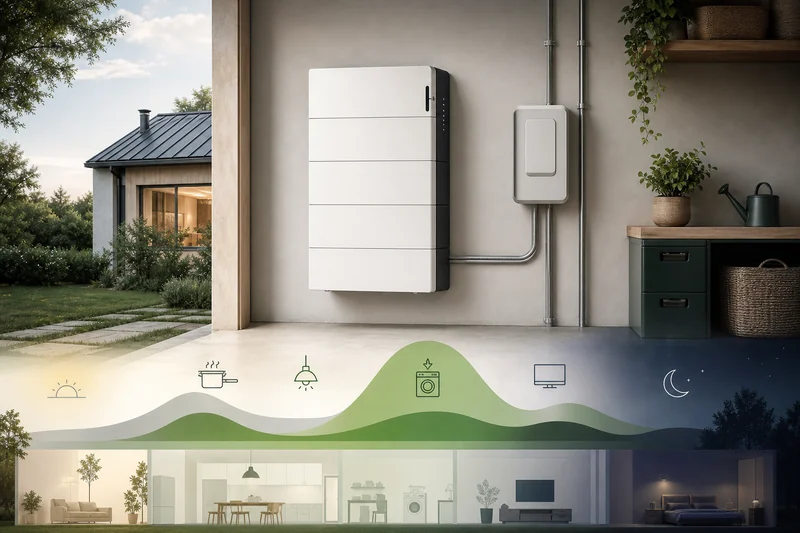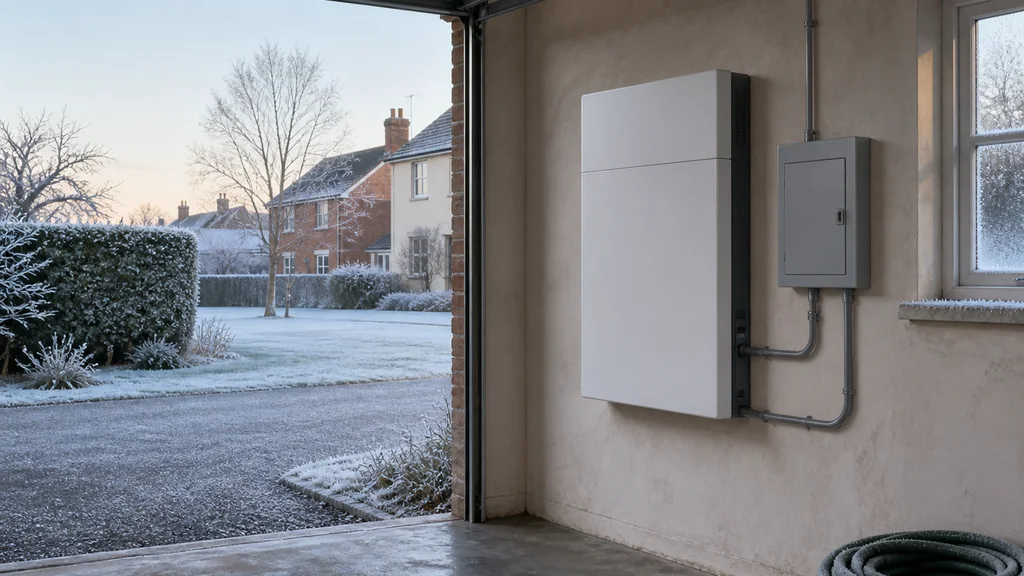
It is a cold January morning, the sun is out, and your battery is not charging.
Nothing is broken. What has almost certainly happened is that the battery has reached its lower temperature limit and its management system has stopped charging to protect the cells. Most owners have no idea this limit exists until the first hard winter, because it rarely comes up during the sale.
This article is about what actually happens, why the limit is there, and what to check before you buy so it does not surprise you.
Cold does two different things to a battery
The first is mild and expected. Almost every home battery uses lithium chemistry, and the chemical reaction that stores and releases energy slows as temperature drops. On a cold day the battery holds slightly less usable energy, and both charging and discharging run more slowly. That is normal behaviour, designed around by every manufacturer, and not worth worrying about.
The second is the one that catches people out. Charging is more temperature-sensitive than discharging. A battery that will happily continue supplying your house on a freezing night may refuse to accept charge in the same conditions.
Why charging is the stricter limit
Charging a lithium cell when it is too cold is the point where real damage can occur. If charge is pushed into a cold cell, the reaction can go wrong in a way that deposits metallic lithium inside the cell instead of storing energy properly. That is cumulative and permanent. It permanently reduces how much the battery can hold, and in badly managed systems it has been associated with more serious faults.
So the battery management system does the sensible thing. It slows the charge rate, or stops charging altogether, until the cells come back into range.
When your battery stops charging in a cold snap, that is the protection working. It is not a defect, and it is not something to fix by overriding.
The bit that makes this a real problem
Consider what those two facts mean together in a British winter.
Your battery is in an unheated garage, an outbuilding, or on an external wall. There is a run of frosty days. The battery continues discharging in the evening as usual, but each morning it declines to recharge because it is below its charging threshold. It empties, and it does not refill.
You are now paying peak rates for everything, in the exact week you were relying on it most, and the app is not showing an error because nothing is wrong.
This matters even more if you bought the battery partly for backup during outages. Winter is when the power is most likely to go off, and winter is when an unheated battery is least able to refill itself.
Heated batteries exist, and are worth asking about
Some batteries include integrated heating, or self-heating cells, which warm the pack enough to accept charge in conditions where an unheated unit would refuse.
That capability costs something. It draws a small amount of energy to run, so there is a modest parasitic loss across the winter, and heated models generally cost more up front. Whether that trade is worth making depends entirely on where the battery is going to live. For a unit in a heated utility room it is largely irrelevant. For one in a detached garage in Lincolnshire, it may be the difference between a battery that works in February and one that does not.
The tension nobody points out
There is a genuine conflict here, and you should see it rather than have it hidden.
Fire-safety guidance for home battery storage points towards siting batteries outside the dwelling and away from habitable rooms. Cold-weather performance points the other way, towards somewhere sheltered and thermally stable.
Both concerns are legitimate. They pull in opposite directions, and the resolution is specific to your property: which outbuilding, how exposed, whether the unit is rated for external mounting, and whether it has heating. That is a conversation to have with your installer before the position is chosen, not after the concrete pad is down.
What to check on the datasheet before you buy
Manufacturers publish this, but you usually have to go looking. Ask for the datasheet and find:
- The operating temperature range for discharging.
- The operating temperature range for charging, which is the stricter of the two and the number that matters.
- Whether the unit has integrated heating or self-heating cells, and what it draws to run them.
- Whether the unit is rated for external mounting, if that is where it is going.
- What the system does when it hits the limit, and whether that is visible in the app or silent.
If an installer cannot produce those figures for the specific model quoted, that is worth noting in itself.
Looking after it through winter
- Check the app occasionally through cold spells. You are looking for a battery that is discharging normally but not recharging, which is the signature of the temperature limit.
- Keep vents, enclosure grilles and outdoor units clear of snow, ice and leaf litter so airflow is not blocked.
- Do not override the automatic charge and discharge limits. They are protecting an expensive asset.
- If you rely on backup power, do not assume winter performance matches summer. Check the manufacturer’s cold-weather guidance for your model.
- If something looks genuinely wrong, such as an error light, a sudden drop in reported capacity, or charging that stops and will not resume once temperatures recover, contact your installer or the manufacturer rather than investigating the unit yourself.
What to ask before you sign
- What is the minimum charging temperature for this specific model?
- Where are you proposing to put it, and what temperatures does that location actually reach in January?
- Does this unit have heating, and if not, what is the alternative for that location?
- Is this model rated for external mounting?
- If I am buying this partly for winter backup, will it be able to recharge itself in a cold snap?
The short version
Cold weather is a normal, manageable part of owning a home battery in the UK. It is not a reason to rule one out.
But a battery has a minimum charging temperature, that limit is stricter than the one for discharging, and where you put the unit determines whether you ever meet it. Ask the question before the battery is on the wall, because moving it afterwards is a job in itself.
What Eco Connect does, and does not, do here
We give independent advice on what a battery would and would not do for your property, including whether its proposed position will cause you problems in winter. We do not install and we have nothing to sell you here. Installation is carried out by your chosen installer.