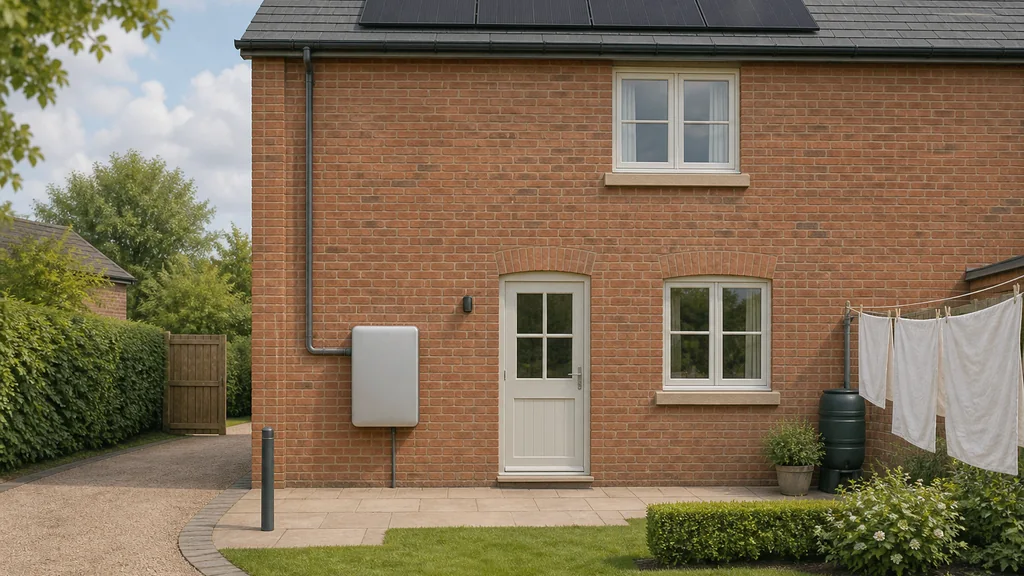
“Can it go in the loft?”
It is one of the first questions people ask about a home battery, because the loft is out of the way and nobody minds what it looks like up there.
The answer is no, and it is not a matter of opinion. PAS 63100:2024, the British specification covering protection against fire of battery energy storage systems in dwellings, lists voids, roof spaces and lofts among the locations where batteries are not to be installed.
That document is worth knowing about before you choose a battery, because it also settles several other questions people usually leave to the installer.
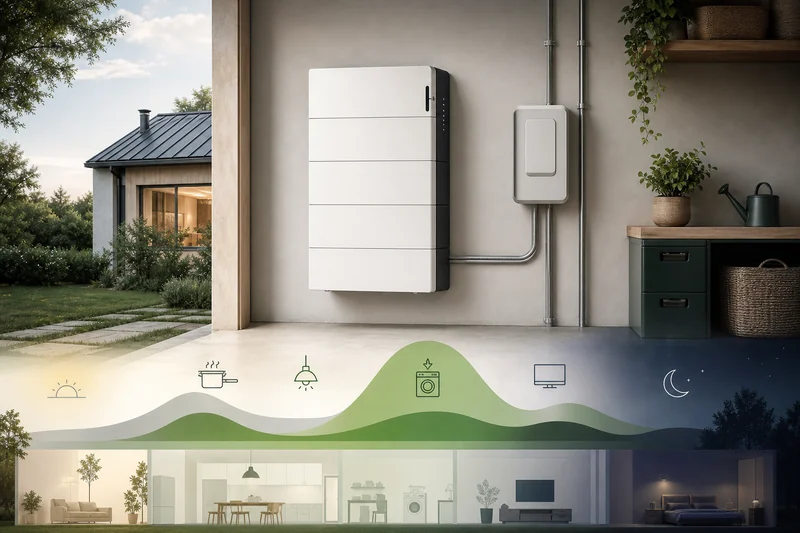
The starting position: outdoors
The specification does not treat indoor and outdoor siting as equal options.
Its requirement is that storage batteries are installed outdoors where practicable. Indoor installation is what you do when outdoors is not practicable, and even then only in a location that is not on the prohibited list, that has ventilation to outside, and that has fire-resisting separation where required.
It also treats a detached outbuilding not intended for habitation as an outdoor location, provided it is detached or separated by a main wall meeting a specified fire performance.
So if an installer proposes putting a battery in your utility room without discussing whether outdoors was possible first, that is a reasonable thing to question.
Where a battery may not go
The specification lists locations where batteries are not to be installed. In plain terms, these include:
- Lofts, roof spaces and voids
- Rooms where people sleep
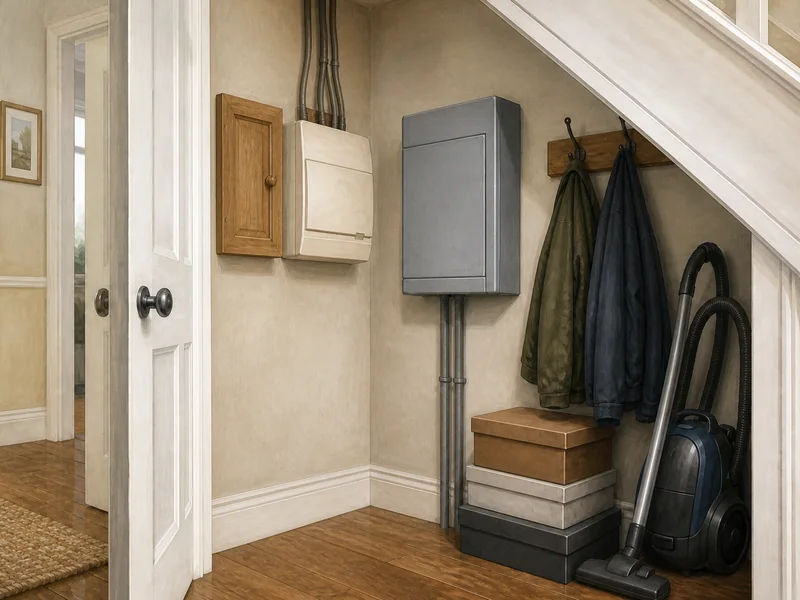
- Escape routes that are not protected escape routes, including landings, staircases and corridors
- Corridors, shafts, stairs or lobbies of protected escape routes
- Firefighting lobbies, shafts or staircases
- Storage cupboards, enclosures or spaces that open into rooms where people sleep
- Cellars or basements with no access to the outside of the building
- Outdoors, within one metre of an escape route, a door, a window, or a ventilation port
- Within two metres of stored flammable materials, or fuel storage tanks or cylinders
Two of those catch people out.
The one metre outdoor rule matters because the obvious spot on an external wall is often right beside a window or a back door. That constraint frequently decides where the battery actually ends up.
The two metre rule catches households that keep petrol cans, gas bottles, or heating oil in the garage. A battery and a jerry can at opposite ends of the same garage is a different proposition to a battery and a jerry can side by side.
If it does go indoors
Where an indoor location is used, three further things apply.
Ventilation. Indoor locations containing storage batteries need fresh-air ventilation to outdoors, and the ventilation must not compromise the fire resistance of the enclosure. Outdoor ports for that ventilation have their own one metre separation from doors, windows and other ventilation ports.
The specification also notes that air tightness requirements for dwellings might rule out batteries in the habitable parts of a home altogether. That is worth sitting with: modern airtight construction can make an indoor battery impractical regardless of anything else.
Fire-resisting separation. An indoor location has to be separated from the prohibited locations by walls, ceilings and floors meeting a stated minimum fire performance.
Detection. Where a battery goes somewhere infrequently visited, such as a store cupboard, a smoke or multi-sensor detector is required in that location, interlinked with the fire detection and alarm system in the rest of the dwelling. If the house has no interlinked system, that becomes part of the job.
The limits nobody mentions
Two capacity limits sit in the specification, and neither tends to come up in a sales conversation.
Per enclosure: the total energy stored within a single battery enclosure is not to exceed 20 kWh.
Per dwelling: the total stored energy of all units in an individual dwelling house is not to exceed 80 kWh where the batteries are in a detached garage or outbuilding, outdoors, or in an attached garage or outbuilding with a specified fire separation, and 40 kWh in all other cases.
For most households neither limit binds. But if you are considering a large system, or adding a second battery to an existing one, where the units sit changes the ceiling by a factor of two. That is a design decision worth taking deliberately rather than discovering at the point of installation.
Garages, driveways and impact
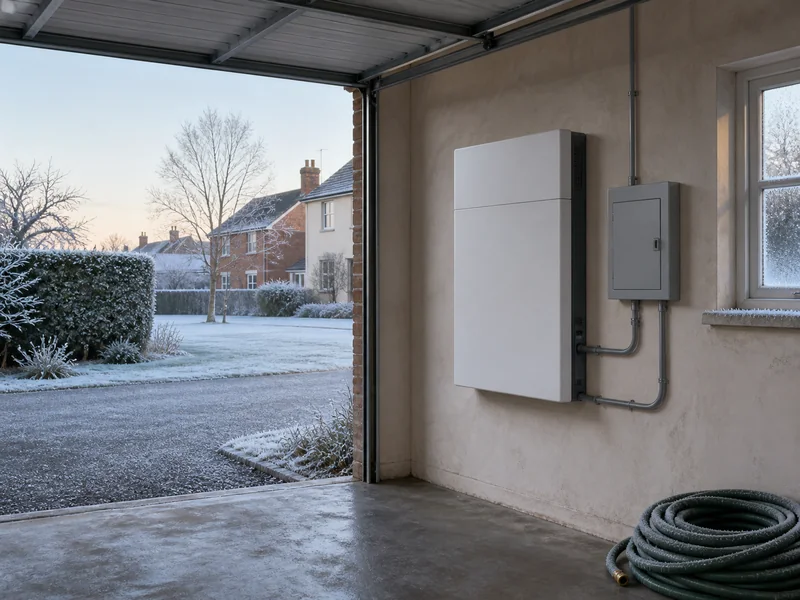
If a battery is installed adjacent to a driveway or other vehicle parking or movement area, on a wall adjoining a public highway, inside an attached or detached garage, or next to indoor parking, it needs a specified minimum degree of protection against mechanical impact, or equivalent protection such as an impact barrier.
In other words, a battery in a garage is permitted, but not simply bolted to the wall where a car door or a bumper can reach it.
The specification also notes that some of these locations may be subject to planning restrictions, which can make the location unsuitable and send you back to choosing somewhere else.
The tension with winter, stated honestly
Everything above pushes a battery outdoors. Cold pushes the other way, because lithium cells have a minimum charging temperature and an unheated outbuilding in a Lincolnshire January can sit below it for days.
The fire specification does not resolve that for you. It sets out where a battery may go; it does not address ambient temperature or cold-weather performance, which is manufacturer territory and belongs on the datasheet.
So the two questions have to be answered together: which locations are permitted for this property, and which of those permitted locations will actually let the battery work in February. Answering one without the other is how people end up with a compliant battery that stops charging every cold snap, or a warm battery in a place it should not be.
What this applies to
PAS 63100:2024 is a specification, written in the language of requirements rather than suggestions. It sits alongside BS 7671, the wiring regulations, rather than replacing them: the specification requires that the battery is selected and erected in accordance with BS 7671.
It is aimed at new installations. If you already have a battery somewhere this specification would not permit, that does not make your installation unlawful, and this article is not a reason to panic. It is a reason to raise it with a qualified installer and get an informed view on your specific system.
BS 7671 changed this year, and the old version goes in October
The wiring regulations themselves have moved. The IET and BSI published Amendment 4:2026 to BS 7671:2018 on 15 April 2026, and the IET states that the previous version is withdrawn six months from that date, which is around 15 October 2026.
It matters here because Amendment 4 introduces a new chapter on stationary secondary batteries. The IET describes it as covering system design, power conversion equipment and bidirectional or hybrid inverters, the suitability of protective devices where energy flows in two directions, which is what vehicle to home and vehicle to grid arrangements need, and what it calls a strong emphasis on safety-critical matters including appropriate battery location, ventilation and fire-risk mitigation.
In other words, battery placement is no longer only a PAS 63100 question. It now sits in the wiring regulations too.
Three things follow from that, and none of them is a reason to panic.
If you already have a battery, nothing about your installation becomes unlawful on 15 October. BS 7671 is not a statute, and an amendment is not applied backwards. The same point made above about PAS 63100 applies here.
If you are getting quotations now for work that will be commissioned after mid-October, ask which version of BS 7671 the design has been done to. It is a fair question, an installer working properly will have a straight answer, and the answer tells you something about how current they are.
We cannot tell you what the new chapter actually says, clause by clause, and neither can anyone else who is quoting it at you for free. BS 7671 is a purchased standard. What we can tell you is that it exists, when it takes over, and that battery location is explicitly among the things it deals with. For the requirements themselves, your installer works to the standard and should be able to explain their reasoning against it.
Sources: IET, “IET and BSI officially publish Amendment 4 (2026) to BS 7671:2018 (IET Wiring Regulations)”, 15 April 2026, checked 15 September 2026, https://www.theiet.org/media/press-releases/press-releases-2026/press-releases-2026-april-june/15-april-2026-iet-bsi-officially-publish-amendment-4-2026-to-bs-76712018-iet-wiring-regulations
What to ask before you sign
- Have you considered an outdoor location, and if you are proposing indoors, why is outdoors not practicable here?
- Does the proposed position meet the one metre separation from doors, windows, escape routes and ventilation ports?
- Is anything flammable stored within two metres, and has that been checked rather than assumed?
- If it is going indoors, what ventilation, fire separation and detection does that location need, and is all of it in this quote?
- What is the total stored energy, and does the location we have chosen put us under the higher or the lower dwelling limit?
- If it is going in a garage or near the drive, what impact protection is included?
- Will this position let the battery charge in winter, and what is its minimum charging temperature?
Question seven is the one that will not be in the standard, and the one you are most likely to feel in January.
The planning position, stated honestly
We looked for a national permitted development class covering domestic battery storage, and for national siting or fire guidance aimed at householders. We did not find one from a primary source. We are not going to invent a rule to fill the gap.
What government guidance does say is aimed at larger systems. Where planning permission is being sought for battery energy storage systems of 1 MWh or over, expressly excluding systems associated with a residential dwelling, applicants are encouraged to engage with the relevant local fire and rescue service before submitting an application, so that siting, prevention of thermal runaway and emergency services access can be considered beforehand. Local planning authorities are encouraged to consult the fire and rescue service in turn.
Note the exclusion: that guidance is explicitly not about a battery in a domestic garage. The standard described above governs where a domestic battery may go. The planning position is a separate question, and for a battery at a house, farm or small business it depends on where it goes, how big it is, what it is attached to and what designations apply to the property. Ask your local planning authority directly. It is a short call and it is free to ask.
Source: GOV.UK planning practice guidance, “Renewable and low carbon energy”, paragraphs 002, 034 and 035, last updated 14 August 2023. Checked 17 August 2026. https://www.gov.uk/guidance/renewable-and-low-carbon-energy
What Eco Connect does, and does not, do here
We give independent advice on renewable energy decisions, including which questions to put to an installer before you commit. We do not install, and we do not assess or certify installations. That work is carried out by your chosen installer under their own certification.
Requirements described here are drawn from PAS 63100:2024, published by BSI. This article summarises the effect of those requirements in our own words and is not a substitute for the standard itself.