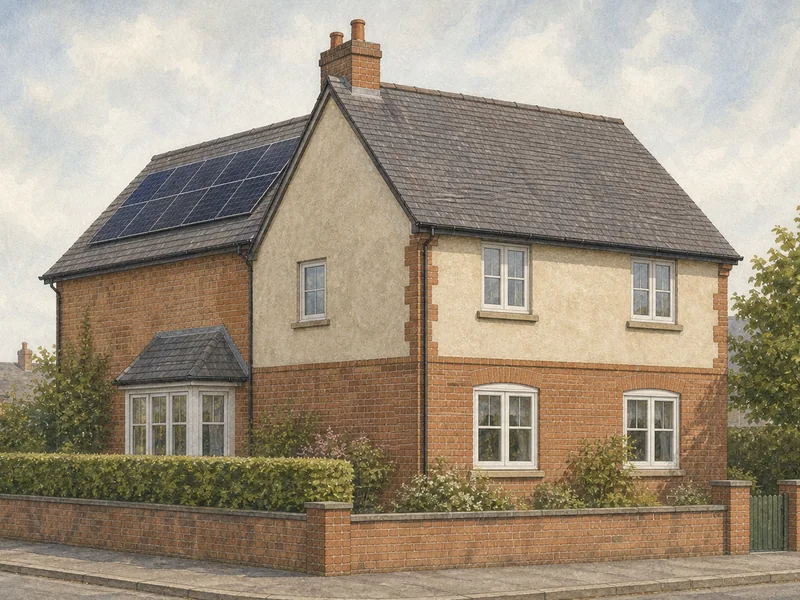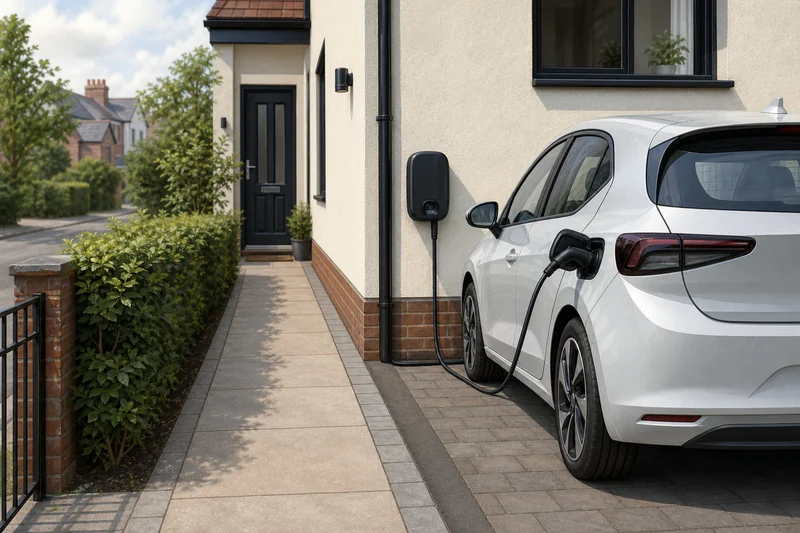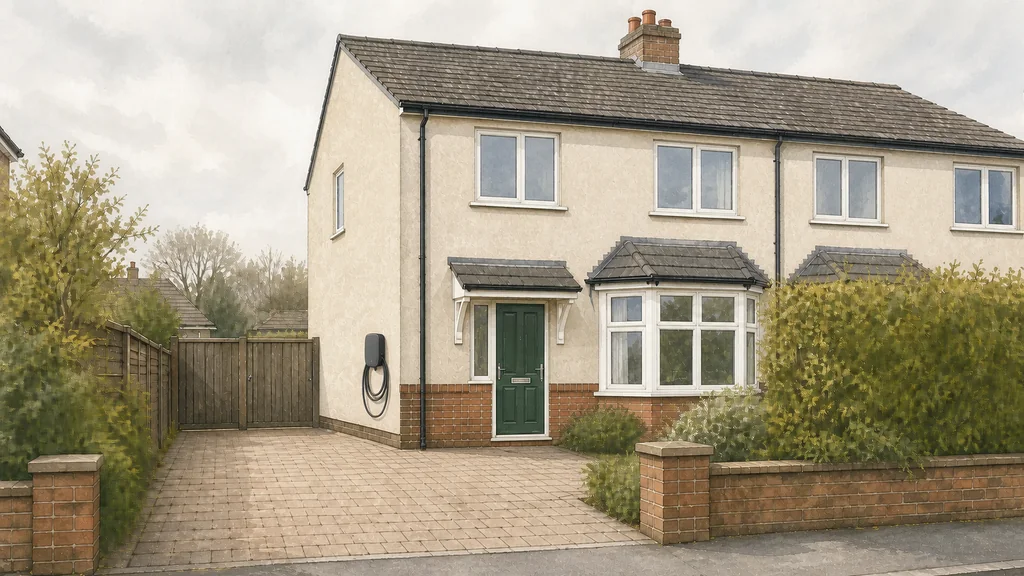
A home charge point is classed as development, so the permissions are your responsibility as the householder, not the installer’s. That distinction matters, because an installer who quotes without raising it has not necessarily checked it.
If your home has off-street parking, installation is likely to fall under permitted development, provided the following are met.
A wall-mounted charging outlet must not exceed 0.2 cubic metres including its casing, must not be on a scheduled monument, and must not be within the curtilage of a listed building.
An upstand with a charging outlet mounted on it must not exceed 2.7 metres in height from the parking surface, reduced to 1.6 metres within the curtilage of a house or block of flats. It must not be on a scheduled monument or within the curtilage of a listed building, and there must be no more than one upstand per parking space.
For both, when the outlet is no longer needed as a charging point, the wall or the land must be returned to its previous condition as soon as possible.
Planning permission is normally required for on-street parking, in conservation areas, for listed buildings, where an article 4 direction applies, and for more than one upstand per parking space.
Source: Planning Portal, “Permitted development for electric vehicle chargers”, citing GPDO 2015, Schedule 2, Part 2, Classes D and E. Checked 17 August 2026. https://www.planningportal.co.uk/permission/common-projects/electric-vehicle-charging/permitted-development/
A common misunderstanding worth clearing up
Approved Document S of the Building Regulations requires EV charge points and cable routes in new buildings, buildings undergoing a material change of use to dwellings, and buildings undergoing major renovation. It does not impose a requirement to retrofit a charge point to an existing home. If you are being told otherwise, check the source.
Source: GOV.UK, “Approved Document S: Infrastructure for charging electric vehicles, frequently asked questions”, published 17 April 2023. Checked 17 August 2026. https://www.gov.uk/guidance/approved-document-s-infrastructure-for-charging-electric-vehicles-frequently-asked-questions
The question behind the question
Permission is rarely the hard part of a charge point. The harder question is what else the property is being asked to carry. A charge point is a substantial electrical load added to a property that was wired before anyone in it owned an electric car, and it sits alongside whatever else has already been added, or is about to be.
If solar or a battery is also being considered, the sensible order is to work out the whole picture once rather than three times. What the incoming supply and the consumer unit will take is a single question, not three separate ones, and answering it late is how people end up paying for the same electrician twice.
Information correct as of 17 August 2026. Check the linked sources before you rely on them.