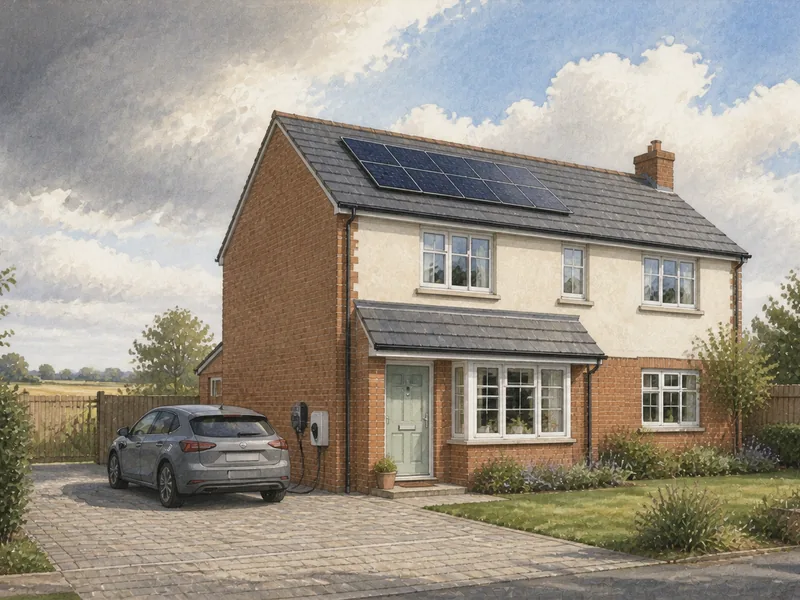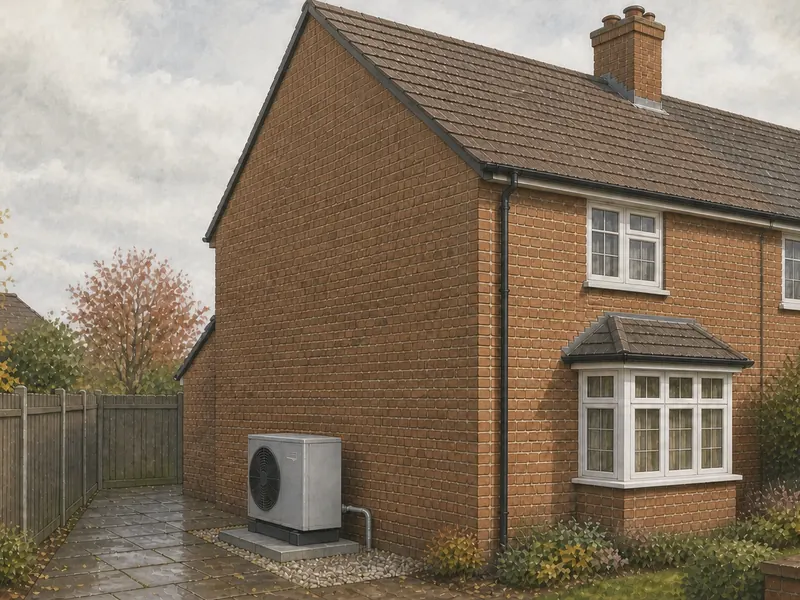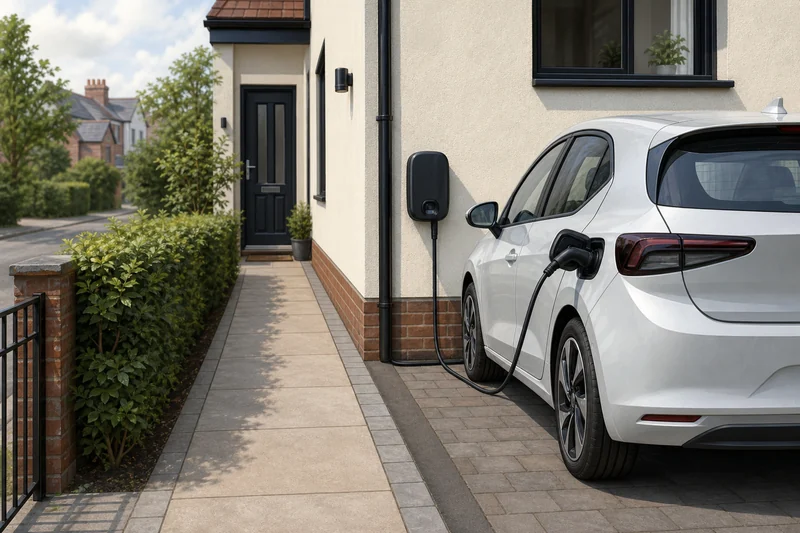
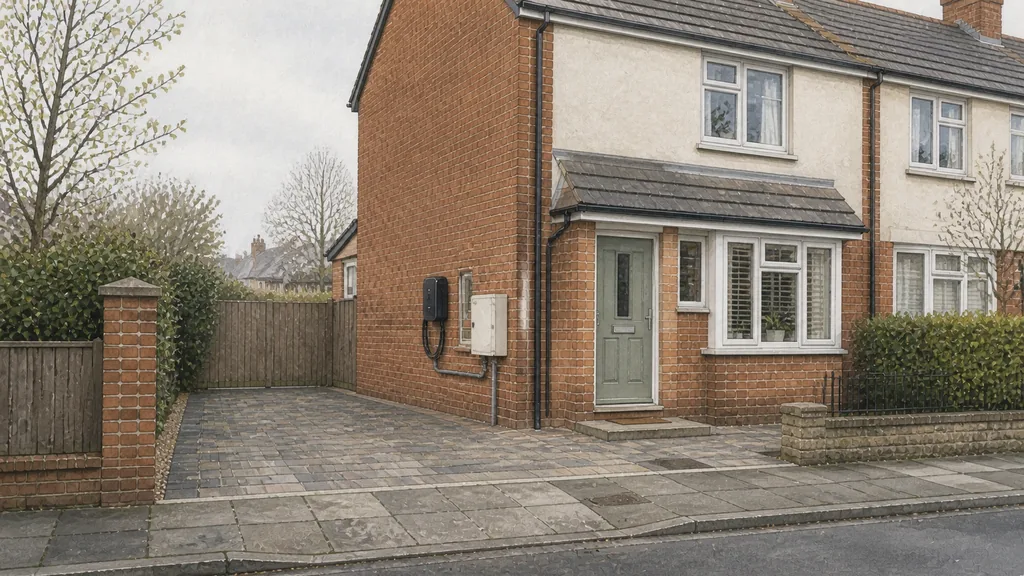
The charge point is the cheap part. What decides whether a home installation is a straightforward morning’s work or an expensive project is the property it is going on, and almost all of that can be established before anyone quotes.
Eco Connect Services is an independent advisory business. We do not install charge points, we hold no installation accreditation, and we are not an OZEV authorised installer. Where installation work is appropriate it is carried out by a vetted delivery partner, and the final technical advice and the quotation sit with them. This page is the list of things worth settling first.
Start with the parking, because everything follows from it
Off-street parking is the gate. Not “somewhere to put the car”, but a space you have a legal right to use and can reach with a cable without running it across a public footway.
This is not just a practical point. It is written into the grant rules. The chargepoint grant for renters and flat owners requires designated, private off-street parking that you can demonstrate a legal entitlement to and can access at all times, and it says your installer will assess whether that space allows a vehicle to charge safely.
If you do not have off-street parking, you are not out of options, but you are in a different process. The grant for households with on-street parking exists precisely for that case, and it requires you to install a permanent cross-pavement solution such as a cable channel. Temporary things such as cable covers or mats laid over a cable do not qualify. It also requires consent from your local highways authority before you apply, and you must not install a cross-pavement solution on the public road network yourself.
One detail worth knowing in a two-tier council area: the highways authority and the planning authority may be different bodies. In much of England the county council is the highways authority and the district council is the planning authority. That is two conversations, not one.
Sources: GOV.UK Find a grant, “Electric vehicle chargepoint grant for renters and flat owners”; GOV.UK Find a grant, “Electric Vehicle Chargepoint Grant for Households with On-Street Parking”. Both checked 18 August 2026.
The cable run, which is where the money goes
Once the parking is settled, the next question is how far the electricity has to travel and what it has to travel through.
The distance from your consumer unit to the charge point position is the biggest single driver of installation cost that is under nobody’s control. A charge point on a garage wall two metres from the consumer unit is one job. The same charge point at the far end of a long drive, past a conservatory, under a patio and through a flower bed, is a different job, and the difference is labour, cable and reinstatement rather than equipment.
Things worth walking with a tape measure before you ask for a price:
- where the consumer unit actually is, and whether there is spare capacity in it;
- the route the cable would have to take, and what it crosses: soft ground, block paving, concrete, a wall you would rather not chase;
- whether the run is external, internal, or both, because that changes the containment needed;
- whether the position you want the unit in is reachable by a charging cable from where the car actually parks, given that different cars have their charging inlet in different places;
- whether anything else is planned for the same route, because doing a cable run once is cheaper than doing it twice.
That last point is the one people skip. If solar, a battery or a heat pump is anywhere in your thinking, the electrical design is one design and not three. It is considerably cheaper to decide that now than to discover it later.
What the incoming supply can carry
A charge point is a substantial, sustained load. Approved Document S sets a minimum nominal rated output of 7kW for a charge point installed to meet its requirements, and unlike a kettle or a shower that load runs for hours at a time.
It joins whatever else has already been added to a property that was wired before anyone in it owned an electric car. An induction hob, an electric shower, a heat pump, a hot tub. The incoming supply was sized for none of them.
The questions to establish, before anyone quotes:
- what the rating of your incoming supply and main fuse actually is;
- whether the supply is single or three phase;
- the condition of the consumer unit and whether it has spare ways;
- what else is already on the supply, and what else you intend to add;
- whether load management is being proposed, and if so what it will do to charging speed when the house is busy.
None of that is exotic and a competent installer will check all of it. The reason to know the questions is so that you can tell the difference between a survey and a sales visit.
Earthing, and why we are not going to explain it
Earthing arrangements are the technical issue most likely to turn a simple charge point install into a complicated one, and they are also the issue we are least willing to summarise for you.
Here is what we can tell you with a source behind it. Approved Document S requires a charge point installed to meet its requirements to meet BS 7671 and the requirements in the IET’s Code of Practice: Electric Vehicle Charging Equipment Installation, and to be a minimum of a Mode 3 specialised system running from a dedicated circuit as defined in BS EN IEC 61851-1. Approved Document S also states plainly that it does not itself provide guidance on electrical safety, and points to Part P of the Building Regulations and the Electricity at Work Regulations 1989.
What we will not do is paraphrase the earthing requirements of a safety standard. They are detailed, they are property specific, and getting them wrong is dangerous rather than merely expensive. They are a competent person’s job, which is exactly why the standard exists.
What this means for you in practice: ask your installer what earthing arrangement your property has, what they propose to do about it, and what that adds to the price. If the answer is confident and specific, good. If the question is brushed aside, that tells you something.
Source: Ministry of Housing, Communities and Local Government, “Infrastructure for charging electric
vehicles: Approved Document S”, 2021 edition, paragraphs 0.9, 6.1 and 6.2. Checked 18 August 2026.
https://www.gov.uk/government/publications/infrastructure-for-charging-electric-vehicles-approved-document-s
Flats, shared parking and whose permission you need
If you live in a flat, or your parking is communal, the electrical questions are the easy half.
The grant rules for renters and flat owners are explicit about it: any third party permission required to install the chargepoint, such as from a landlord, a freeholder or the managing agent of a block of flats, must be obtained before applying for a grant, and OZEV may ask to see it at any time. If you are renting, that means written permission from your landlord or property manager, naming the person giving it, naming you, and giving the address. If you own your flat, it means the same thing from the freeholder or property manager.
Note the order. Permission first, application second, installation third. The grant cannot be backdated and the charge point must not be installed before OZEV confirms you are eligible.
For a shared car park there is a further layer: you need a space you have a legal entitlement to and can access at all times. A first come, first served communal car park does not give you that, which is why the separate landlord grant exists and why the sensible move in a block is often to talk to the managing agent about a scheme for the building rather than to pursue one space alone.
Source: GOV.UK Find a grant, “Electric vehicle chargepoint grant for renters and flat owners”. Checked 18 August 2026.
Planning permission: usually not needed, and here is the actual rule
A wall mounted charge point at a house is normally permitted development, which means planning permission is granted nationally rather than applied for from your council. The rule sits in Class D of Part 2 of Schedule 2 to the Town and Country Planning (General Permitted Development) (England) Order 2015.
Class D permits the installation, alteration or replacement, within an area lawfully used for off-street parking, of an electrical outlet mounted on a wall for recharging electric vehicles. It does not apply if the outlet and its casing would exceed 0.2 cubic metres, if it would be within a site designated as a scheduled monument, or if it would be within the curtilage of a listed building. There is a condition attached: when it is no longer needed as a charging point it must be removed as soon as reasonably practicable, and the wall reinstated so far as reasonably practicable.
A free standing unit rather than a wall mounted one falls under Class E, which permits an upstand with an outlet within an area lawfully used for off-street parking, subject to a height limit of 1.6 metres from the parking surface within the curtilage of a house or block of flats, the same scheduled monument and listed building exclusions, and a limit of one upstand per parking space.
One change worth knowing about. Class D and Class E used to carry a restriction relating to proximity to a highway. That restriction was removed on 29 May 2025 by S.I. 2025/560. A good deal of material still online describes the old rule. The text above is the current version of the Order, which legislation.gov.uk states is up to date with all changes known to be in force on or before 17 August 2026.
Permitted development is a national right, not a guarantee about your particular property. Listed building status, a conservation area designation or a planning condition on your estate can all change the answer, and the local planning authority is the body that decides. If you are in any doubt, ask them.
Source: The Town and Country Planning (General Permitted Development) (England) Order 2015,
Schedule 2, Part 2, Classes D and E, as amended by S.I. 2025/560 (in force 29 May 2025). Checked
18 August 2026.
https://www.legislation.gov.uk/uksi/2015/596/schedule/2/part/2
Building Regulations: what applies to an existing home, and what does not
There is a building regulation about EV charge points, and it probably does not apply to you.
Approved Document S, which supports Part S of Schedule 1 to the Building Regulations 2010, applies to new residential buildings, new non-residential buildings, dwellings resulting from a material change of use, residential and non-residential buildings undergoing major renovation, and mixed use buildings undergoing relevant work. Adding a charge point to an existing house you already live in is not in that list. Part S does not require you to install one and does not set the standard for the one you choose.
What does apply is Part P, electrical safety in dwellings. Approved Document S says so directly: where electrical work is carried out for a dwelling, Part P of the Building Regulations must be met. Installing a charge point is electrical work in a dwelling.
The practical consequence is straightforward, and it is the same as for any notifiable electrical work: GOV.UK’s position is that you do not need to get building regulations approval yourself if you use someone registered with a competent person scheme. That is the normal route for a charge point installation. If your installer is not registered with a competent person scheme, then somebody has to notify building control, and you should establish which of you it is going to be before the work starts rather than afterwards.
This also cuts the other way. If you are buying a new build, or a property that has recently had a major renovation, Part S may well have required a charge point already. Worth asking.
Sources: Ministry of Housing, Communities and Local Government, “Infrastructure for charging electric
vehicles: Approved Document S”, 2021 edition, paragraphs 0.3 and 0.9, and the publication page’s
statement of scope; GOV.UK, “Building regulations approval: when you need approval”, last updated
24 January 2025. Both checked 18 August 2026.
https://www.gov.uk/building-regulations-approval/when-you-need-approval
The grant, and the fact most homeowners get wrong
If you own a house with a driveway, there is no chargepoint grant for you.
That is worth reading twice, because it is the opposite of what most people assume, and the assumption is left over from a scheme that no longer exists in that form. The eligibility page for the current household grant lists, among the people who cannot apply, anyone who lives “in a house that you own (not a flat that’s part of a house)”.
What does exist, as at 18 August 2026, is a smaller set of schemes. OZEV’s home and workplace chargepoint grants have been extended for what OZEV itself calls a final year, with funding confirmed until 31 March 2027. The two that apply to households are:
- The chargepoint grant for renters and flat owners. You can get 75 per cent off the cost to buy and install a socket, up to a maximum of £500. You qualify if you either own and live in a flat, or rent and live in any residential property, including shared ownership. You need private off-street parking, an eligible vehicle, third party permissions obtained in advance, an OZEV authorised installer and a chargepoint from the approved model list. You cannot apply if you are a lodger in a home where the landlord or homeowner also lives.
- The chargepoint grant for households with on-street parking. Same 75 per cent and same £500 maximum, but only where you are also installing a permanent cross-pavement solution, only where you do not have private and exclusive access to off-street parking such as a driveway, garage or residential car park, and only with your local highways authority’s consent.
Three further points that catch people out.
The rate changed. On 1 April 2026 the maximum rate for residents and landlords rose from £350 to £500 per socket. If you applied before that date and your chargepoint has not yet been installed, OZEV’s guidance is that you can re-apply at the new rate, which cancels your existing application. Tell your installer before you do.
You cannot install first. The chargepoint must not be installed before OZEV confirms you are eligible. Neither grant can be backdated.
A mandatory installation is not eligible. If the charge point is required by Part S on a new or renovated building, or by a planning condition, the grant cannot be given for it.
Grant rules change, and this set is explicitly time limited. The government reserves the right to end or change the schemes, and says it will aim to give four weeks’ notice. Check the pages yourself, on the day you need them, before you rely on any figure here including ours.
Sources: GOV.UK, “Electric vehicle chargepoint grants”, Office for Zero Emission Vehicles, last
updated 1 April 2026; GOV.UK, “Changes to electric vehicle chargepoint grant schemes from 1 April
2026”, last updated 7 July 2026; GOV.UK Find a grant, “Electric vehicle chargepoint grant for renters
and flat owners”; GOV.UK Find a grant, “Electric Vehicle Chargepoint Grant for Households with
On-Street Parking”. All checked 18 August 2026.
https://www.gov.uk/guidance/electric-vehicle-chargepoint-grants
https://www.gov.uk/guidance/changes-to-electric-vehicle-chargepoint-grant-schemes-from-1-april-2026
Where the honest answer is “it depends”
Some of this genuinely cannot be answered from a website, and we would rather say so than pretend.
Whether your supply needs upgrading. Depends on the rating of your incoming supply, what is already connected and what you plan to add. It is often fine. It is not automatically fine.
What the installation will cost. Depends on the cable run, the ground it crosses, the earthing arrangement, the state of the consumer unit and whether any of it needs putting right first. Two identical chargers on two identical houses can be very different prices for good reasons.
Whether a faster unit is worth it. Depends on your supply, your mileage and how long the car sits on the drive. A charger you cannot run at full output because the house is busy is not faster.
Whether to wait. Depends on what else you are planning. If solar or a battery is in your thinking, doing the electrical design once is worth more than getting the charger this month.
That is not a hedge. Those are the four questions where a confident general answer would be a wrong answer, and where a survey is the only thing that produces a real one.
Before you ask anyone for a price
- Do I have a parking space I have a legal right to, and can reach with a cable?
- Where is the consumer unit, how far is the run, and what does it cross?
- What is my incoming supply rated at, and is it single or three phase?
- What earthing arrangement does the property have, and what does the installer propose?
- If I am in a flat or a shared car park, who has to give permission, and have I got it in writing?
- Am I eligible for a grant at all, and have I checked rather than assumed?
- Is anything else electrical planned for this property in the next few years?
Whether you need anyone’s permission for the charge point itself is a separate question from the electrical work. EV charge point permissions covers the planning position, including flats, listed buildings and shared parking.
What we do and what we do not do
Eco Connect does not install charge points, does not sell equipment, holds no installation accreditation and is not an OZEV authorised installer. We cannot apply for a grant on your behalf and we cannot certify work. Where installation work is appropriate it is carried out by a vetted delivery partner, and the final technical advice and the quotation sit with them.
What we can do is look at the property with you before anything is ordered: the parking, the run, the supply, and what else you may want to add later. Sometimes the useful advice is to do the electrical work in a different order, or to wait. We would rather say that than sell you a survey you do not need.
If the reason you are considering a charge point is that you already have solar, or are thinking about it, the arithmetic of combining the two is on its own page: can I charge my electric car from solar panels?
Information and source control
Information correct as of: 18 August 2026.
Grant values, eligibility rules and permitted development rules change, and the chargepoint grants on this page are funded only until 31 March 2027. Every rule and figure here is dated and linked to the GOV.UK or legislation.gov.uk page it was taken from. Check the source before you rely on it.