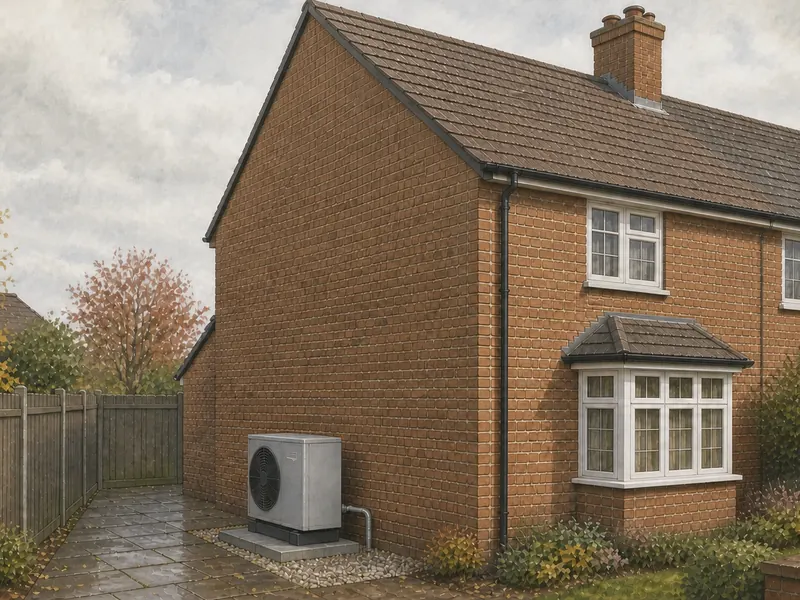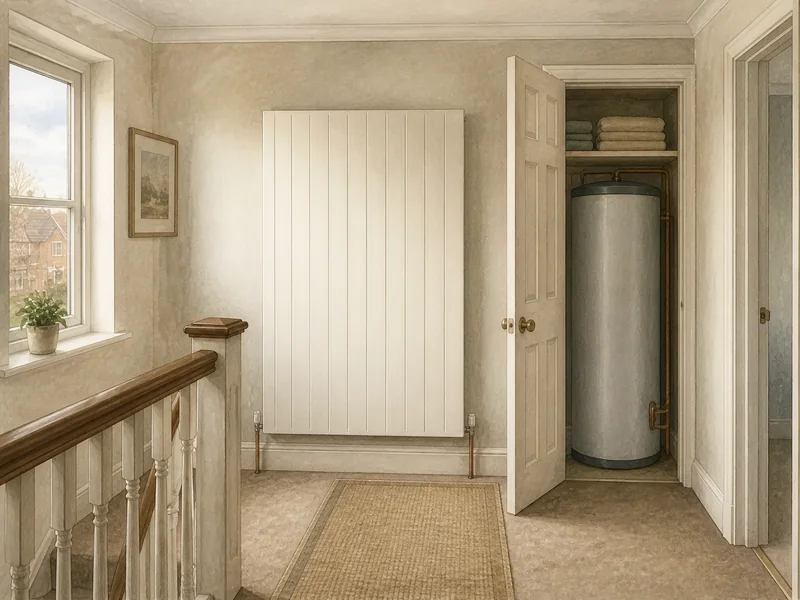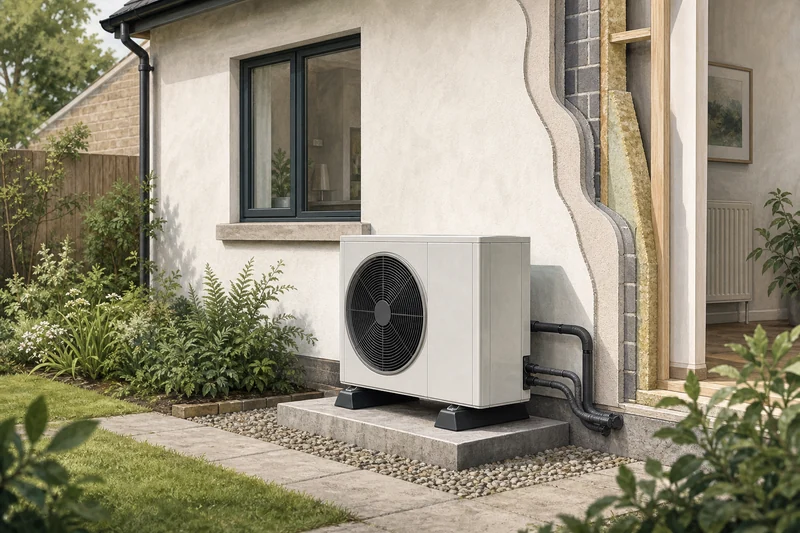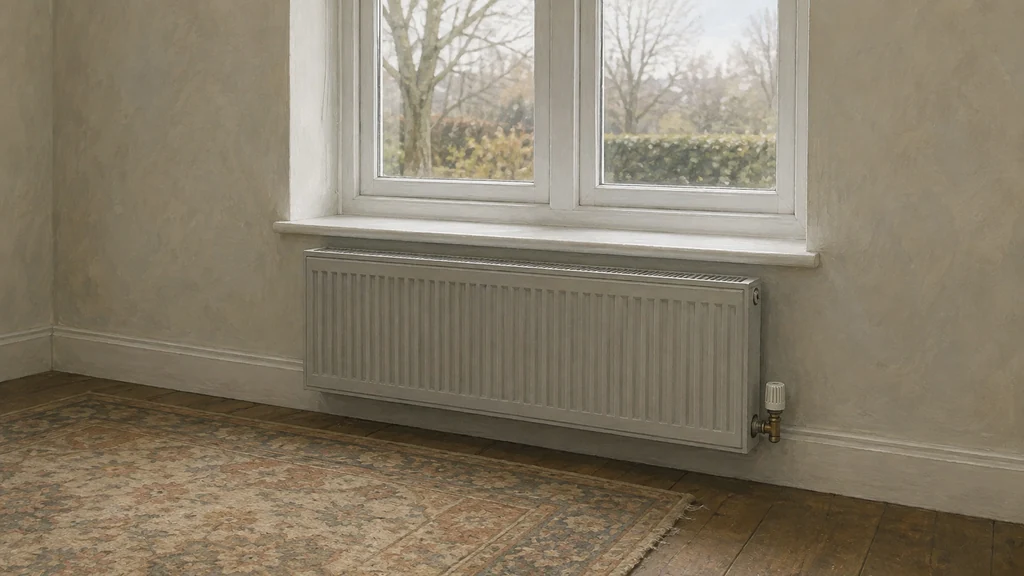
You will hear two claims about this, and both are sales talk. One is that a heat pump means ripping out every radiator in the house. The other is that your existing radiators will be fine. Neither is knowable without a survey, because the answer is decided room by room, not property by property.
Here is the method that actually decides it, so you can tell whether the person quoting you has used it.
Why the question exists at all
A gas or oil boiler typically pushes water round the radiators at something like 70 to 80°C. A heat pump is most efficient when it runs much cooler than that, and it gets less efficient the hotter you ask it to run.
A radiator’s output depends on the difference between the water in it and the air in the room. Drop the water temperature and the same radiator puts out less heat. So the radiator that heated your living room perfectly at 75°C may not heat it at 45°C. That is the whole problem, and it is a physics problem rather than a brand problem.
MCS, the certification scheme that governs heat pump installation in the UK, sets this out directly. Its design standard says high temperature heat pumps “should be avoided unless the application requires a flow temperature higher than 55°C”, and that where a designer proposes to run hotter, “an alternative design using a flow temperature of 55°C or lower should also be provided”.
In other words, the standard expects your installer to try to make the system work at a sensible temperature first, and to show you that alternative if they cannot.
Source: MCS, MIS 3005-D, “Heat Pump: Design Standard”, 2025 version 1.0, clauses 3.4.3 and 3.4.4. Checked 3 September 2026. https://mcscertified.com/wp-content/uploads/2025/02/MIS-3005-D-2025-V1.0.pdf
The star rating, and what it is telling you
MCS publishes a Heat Emitter Guide that grades a design by the flow temperature it needs. Lower temperature earns more stars, because the heat pump runs more efficiently.
| Design flow temperature | Temperature star rating |
|---|---|
| Up to 35°C | 6 stars |
| 36 to 40°C | 5 stars |
| 41 to 45°C | 4 stars |
| 46 to 50°C | 3 stars |
| 51 to 55°C | 2 stars |
| 56 to 60°C | 1 star |
| 61°C and above | No stars, and specialist equipment |
This is worth understanding because it is the trade-off in front of you, stated plainly. Keeping your existing radiators usually means designing at a higher flow temperature, which means fewer stars and a system that costs more to run for as long as you own it. Changing some radiators buys you a lower temperature and a cheaper system to run. Neither is automatically right. It is a decision about capital cost now against running cost later, and it is yours to make once someone has put the actual numbers in front of you.
Source: MCS, MCS 021 Issue 2.1, “Heat Emitter Guide”, June 2025. Checked 3 September 2026. https://mcscertified.com/wp-content/uploads/2025/06/MCS-021-Issue-2.1-Heat-Emitter-Guide.pdf
How the answer is actually calculated
There is no rule of thumb here, and you should be wary of anyone who offers you one. The published method is:
- A room-by-room heat loss calculation. Not a whole-house figure. MCS requires the design to follow BS EN 12831-1:2017, using specified internal temperatures for each room type and an external design temperature for your location. The output is a heat loss in watts for every room.
- An oversize factor for the chosen flow temperature. This is a multiplier. The room’s heat loss in watts is multiplied by it to give the radiator output the room needs at that temperature.
- A comparison against what is on the wall now. Room by room, the existing radiator either makes that output or it does not.
- The worst room sets the temperature for the house. MCS requires the design emitter temperature to be based on the worst performing room, because one system serves all of them.
MCS’s own worked example in the Heat Emitter Guide shows the scale of it: a room losing 976 watts, with an oversize factor of 3.1, needs an emitter producing 3,024 watts. That is MCS’s example rather than ours, and it is not your house. We reproduce it only to show that the multiplier is a real number applied to a real measurement, not a guess.
Point four is the one that surprises people. You do not need every radiator to be adequate. You need the worst one to be, or the whole system runs hotter to compensate for it. This is why a survey sometimes concludes that changing two radiators improves the entire house, and why “how many radiators” is the wrong question. The right one is “which rooms fail, and what does fixing them buy me”.
Source: MCS, MIS 3005-D, clauses 3.8.1(a) and 3.8.1(d), and MCS 021 Issue 2.1. Both checked 3 September 2026.
The thing people forget: the hot water cylinder
If you currently have a combi boiler, you have no hot water cylinder, and a heat pump will need one. This is more often the real obstacle than the radiators, because a cylinder needs floor space or a cupboard that may not exist.
MCS sets the sizing method rather than leaving it to preference. Average daily demand is calculated as 45 litres multiplied by the number of occupants, where that number is taken as the bedrooms plus one, or the known occupancy, whichever is greater. The heat pump must also be able to reach at least 55°C at design conditions for hot water.
So a three bedroom house is assessed on four people whether four live there or not, unless more do. Ask where the cylinder is going before you get as far as radiators. If there is nowhere sensible for it, that is a bigger conversation than pipework.
Source: MCS, MIS 3005-D, clauses 3.5.2, 3.5.3 and 3.5.5. Checked 3 September 2026.
What to ask the person quoting you
Four questions, and the answers tell you a great deal about the quotation:
- What design flow temperature is this quotation based on? A quotation without one is not a design.
- Can I see the room-by-room heat loss figures? They exist, or the design does not comply.
- Which specific rooms fail at that temperature, and what changes in each? Not a count. A list.
- What would the same house cost to run at a lower temperature, with the radiator changes that requires? This is the trade-off, and you are entitled to see both sides of it.
If the answer to any of those is a shrug or a national average, you are looking at a sales estimate rather than a design.
Before radiators, fabric
There is a step before all of this. Every one of those oversize factors is applied to a heat loss figure, and heat loss is a property of the building. Reduce the heat loss and every room needs less output, which means fewer radiator changes and a lower flow temperature at the same time.
The MCS guide says as much: where a system cannot meet the design parameters, the response is to consider reducing heat loss or sharing the load with other emitter types, not simply to turn the temperature up. Whether your property is ready for a heat pump covers what that means in practice.
If you are off the gas grid and heating with oil or LPG, there is currently a higher grant available, and it has an end date. See the £9,000 off-gas-grid grant and the date it ends.
Where our knowledge ends
Eco Connect is an independent advisory business. We do not install heat pumps, we do not size or specify them, and we do not perform MCS heat loss calculations. Those sit with an MCS certified installer, and so does the design liability.
What we can do is read a quotation with you, tell you whether the design work behind it has actually been done, and say plainly when the answer for your property is not yet.
Find MCS certified installers and get more than one quotation: https://mcscertified.com/find-an-installer/
Information and source control
Information correct as of: 3 September 2026.
Standards change. Every requirement on this page is attributed to a numbered clause in a named MCS standard, with the version and the date we checked it. Check the source before you rely on it, including ours.
- MCS, MIS 3005-D Heat Pump Design Standard: https://mcscertified.com/wp-content/uploads/2025/02/MIS-3005-D-2025-V1.0.pdf
- MCS, MCS 021 Heat Emitter Guide: https://mcscertified.com/wp-content/uploads/2025/06/MCS-021-Issue-2.1-Heat-Emitter-Guide.pdf
- Find an MCS certified installer: https://mcscertified.com/find-an-installer/