On an owner-occupied building the question does not arise. One person owns the roof, uses the electricity and pays the bill, and generation straightforwardly reduces what they import.
On a diversified holding it arises constantly, and it is the reason otherwise sensible projects stall after a quotation has been produced.
The question, stated plainly
Three things have to line up for a solar array to be worth what a quotation says it is worth.
- Somebody owns or controls the roof and can consent to work on it.
- Somebody uses electricity in the building underneath it, during daylight.
- Somebody pays the bill that the generation reduces.
Where those are the same party, the arithmetic is simple. Where they are two or three different parties, the saving lands with whoever pays the bill. If that is not the person funding the installation, the project needs a mechanism, not just a design.
Where this shows up on a farm
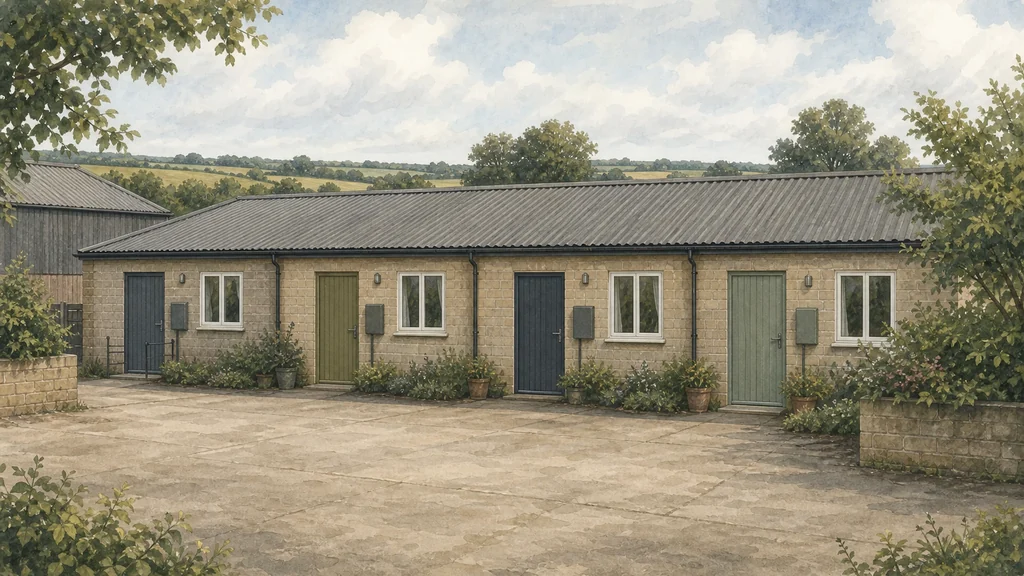
Let units and converted buildings. Workshops, storage, small commercial lettings, holiday accommodation. Each will typically have its own supply and its own meter, and the tenant pays their own bill. An array on that roof, funded by the landlord, reduces the tenant’s costs and not the landlord’s.
Tenanted land and buildings. Where the holding itself is let, the person who wants to install may not be the person entitled to alter the building, and the agreement between them governs what is possible. That is a matter for the tenancy documents and for a solicitor who works in agricultural law, not for an installer and not for us.
Shared or landlord-supplied electricity. Some arrangements bill electricity through the landlord, recharged to occupiers. That changes the answer again, and the mechanism for passing on a saving needs to be deliberate rather than assumed.
Farmhouse on the same supply as the yard. Common, and it works in your favour more often than not, but it also means domestic and business consumption are mixed, which matters for how the expenditure is treated. That is a question for your accountant.
A building used by the farm but owned by another entity in the family. Very common on holdings that have been through succession planning. Worth establishing on paper rather than by memory.
The three routes people actually take
The occupier funds it. Simplest where the occupier has the security of tenure to justify capital spending on someone else’s building. Often they do not, particularly on short lettings, and that is usually what kills it.
The owner funds it and the benefit is shared. This needs an agreed mechanism: a rent adjustment, a supply arrangement, something written down. It is entirely doable and it is not something to leave to good will, because the people who agreed it are not always the people still there in six years.
The owner funds it for a building they use themselves. The cleanest answer, and often the right first project on a mixed holding: start with the building where you own the roof and pay the bill, prove it works, and deal with the let units later.
We are not going to tell you which of those suits your holding. That is a commercial and legal question about your own arrangements. What we will tell you is that it has to be settled before a system is sized, because the answer changes which building you should be looking at.
The planning position is separate
Whether solar is permitted development on a building is decided by the rules for that building, not by who occupies it.
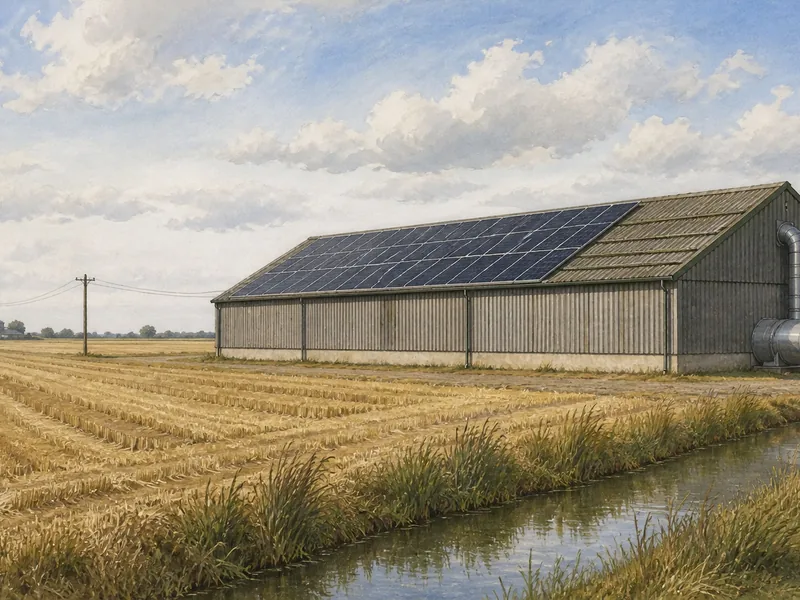
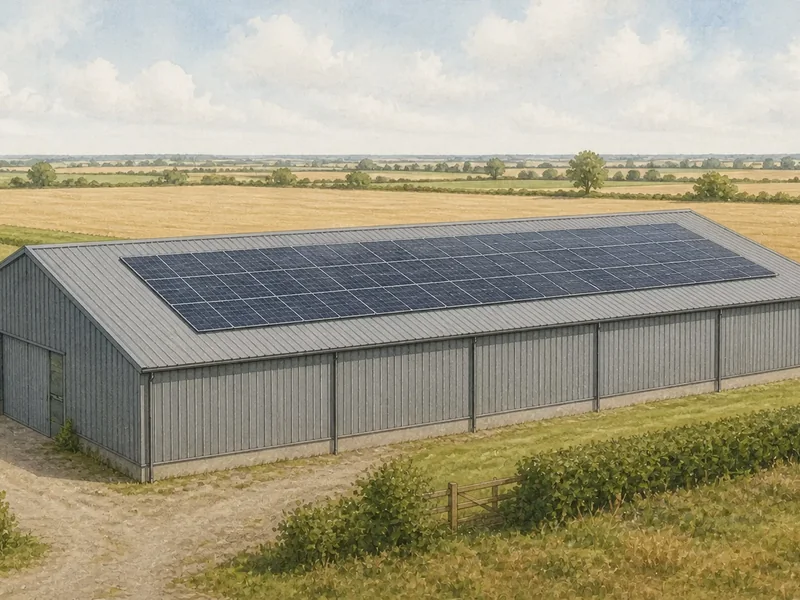
For a building that is not a dwellinghouse there are limits on projection and position, and there is a step that catches people out: where a rooftop array is not microgeneration, meaning a generating capacity above 50 kilowatts, an application must be made to the local planning authority, before the development begins, for a determination as to whether prior approval is required for design and external appearance, including the impact of glare on neighbouring occupiers.
Most farm-scale rooftop arrays worth doing are above that threshold. That is set out in full on our planning hub and in the guide to solar on farm and commercial buildings.
What to establish before anyone designs anything
- Which building, and who owns it.
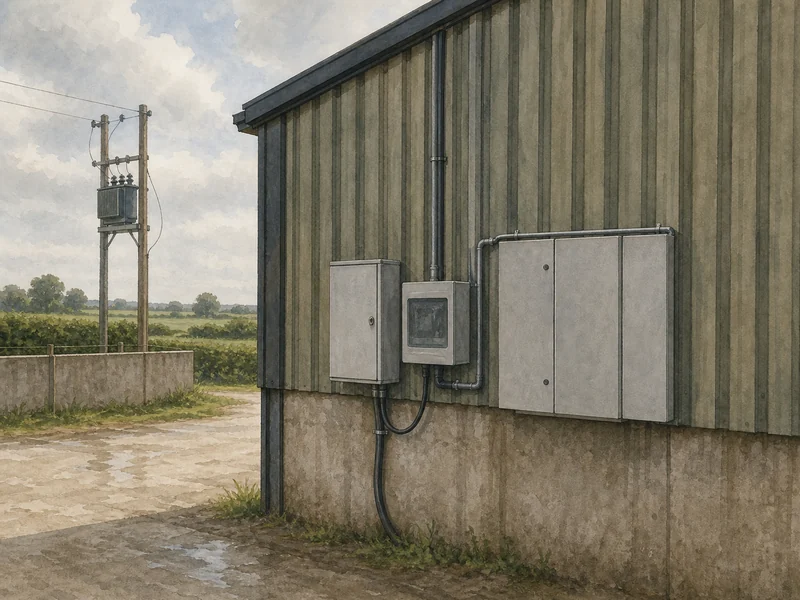
- Which meter serves it, and whose name is on the account.
- Who consumes electricity in it, and when during the day.
- What the tenancy or licence says about alterations, and whether consent is needed.
- If the benefit is to be shared, by what mechanism, recorded where.
- Whether the holding has more than one supply, and which one the array would connect to.
Six answers. They take an afternoon and a look at the paperwork, and they routinely change which roof the project should be on.
What Eco Connect does, and does not, do here
We assess and advise. We do not install, we do not price the work, and we do not advise on tenancy agreements, landlord and tenant law, or tax.
What we do is make sure these questions are asked before a design exists, and make sure a quotation’s savings figure is attributed to the party who will actually receive it. Where the questions are legal ones, we will say so and tell you to take proper advice rather than guess at an answer.
Where work is appropriate, it is carried out by a delivery partner, and the technical design and the quotation come from them.
Information and source control
Information correct as at 1 September 2026.
Planning source: The Town and Country Planning (General Permitted Development) (England) Order 2015, Schedule 2, Part 14, Class J, paragraphs J.1 and J.4(2), checked 19 August 2026, https://www.legislation.gov.uk/uksi/2015/596/schedule/2/part/14; Energy Act 2004, section 82(8)(a), checked 19 August 2026, https://www.legislation.gov.uk/ukpga/2004/20/section/82
Eco Connect is an independent advisory business. It does not carry out installations, holds no installer accreditation, and nothing on this page is planning, legal, tax or financial advice. Questions about tenancies, ownership and the treatment of expenditure should be taken to a solicitor or accountant who acts for you.