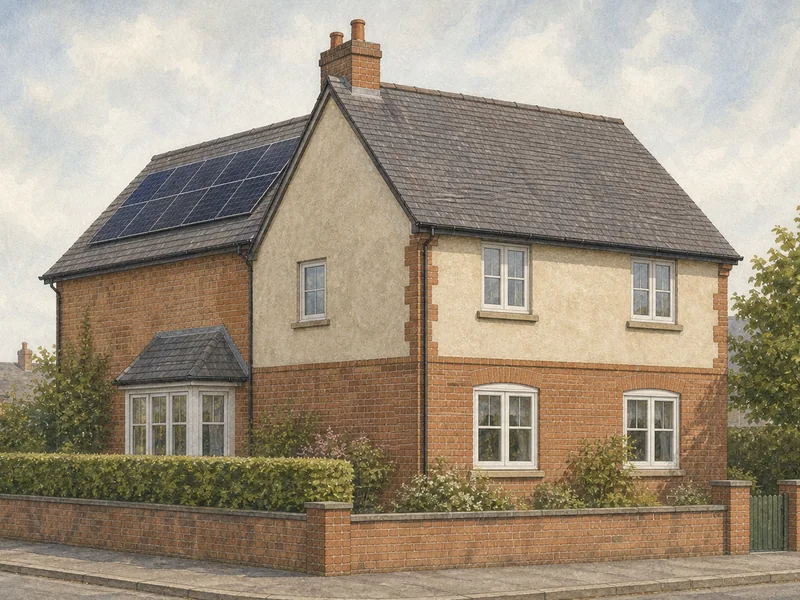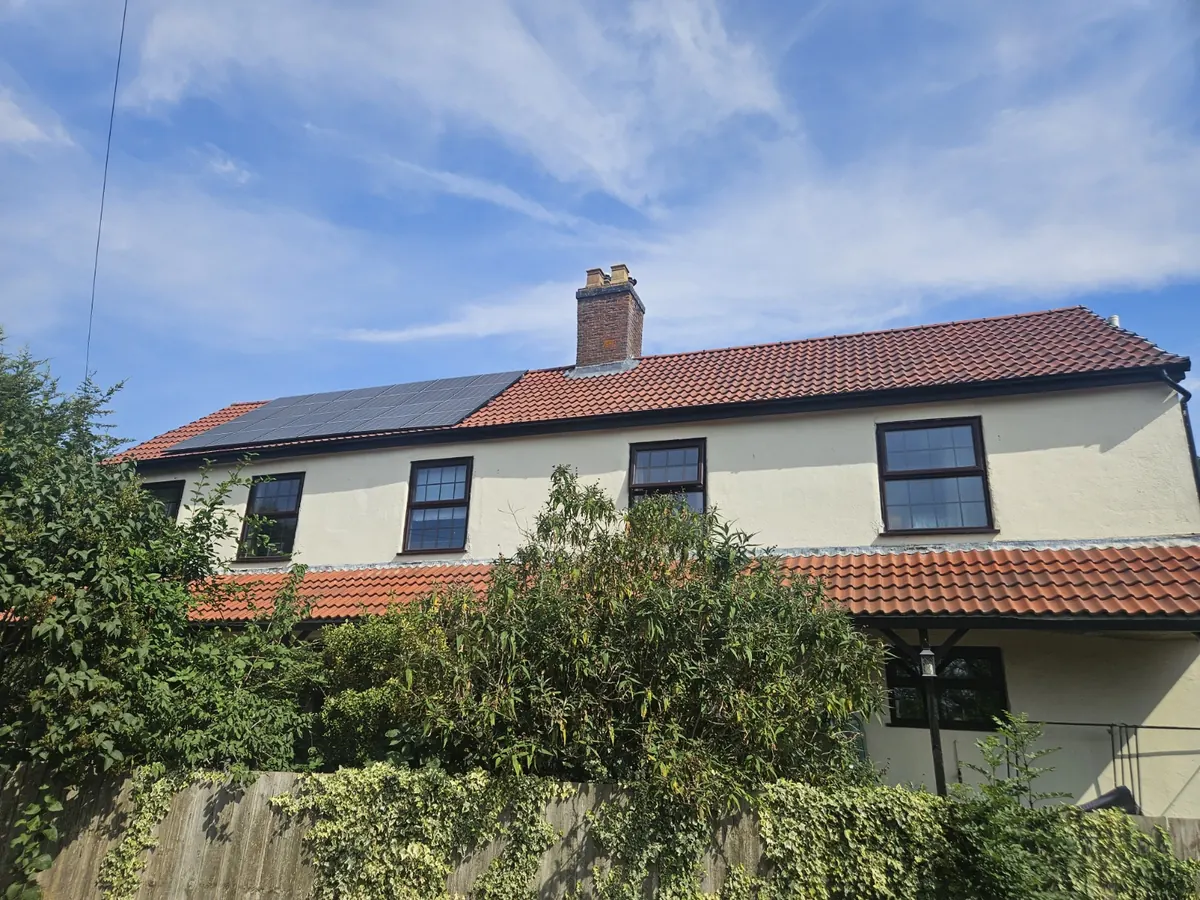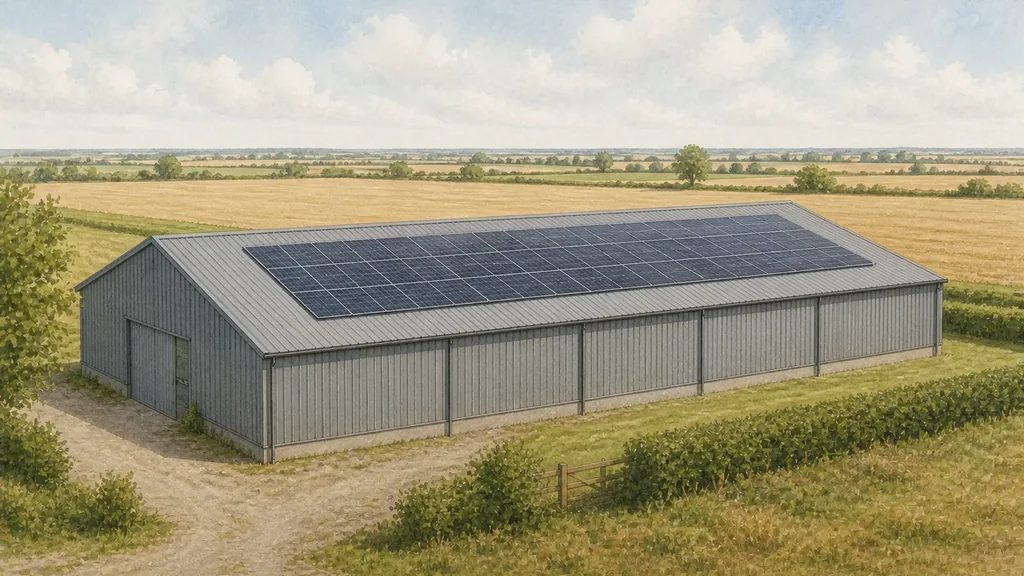
Buildings other than houses and flats are covered by a separate class of permitted development. If you are looking at a barn roof, a workshop or a warehouse, the rules on the domestic pages do not apply to you.
The limits for a non-domestic building
The current limits are that the equipment must not:
- protrude more than 0.2 metres beyond the plane of a pitched roof slope;
- on a flat roof, sit more than 1 metre above the highest part of the roof, excluding the chimney;
- be installed on a roof within 1 metre of the external edge of that roof;
- be installed on a scheduled monument, on a listed building, or on a building in the curtilage of a listed building.
For wall-mounted equipment there are additional limits: no more than 0.2 metres beyond the plane of the wall, not within 1 metre of a junction with another wall or with the roof, and, on article 2(3) land, not on a wall fronting a highway.
That 1 metre edge setback is worth pausing on if you are estimating capacity from a roof plan. It removes a strip from every edge of the usable area, and on a long, narrow agricultural roof that is a larger proportion of the total than people expect.
Source: GPDO 2015, Schedule 2, Part 14, Class J. Checked 17 August 2026. https://www.legislation.gov.uk/uksi/2015/596/schedule/2/part/14
The glare step most people miss
There is an important extra requirement for larger rooftop arrays. Solar PV on the roof of a non-domestic building that is not microgeneration requires an application to the local planning authority, before the development begins, for a determination as to whether prior approval is required as to design or external appearance, and specifically the impact of glare on neighbouring occupiers.
Read the timing in that sentence. It is before the development begins, not alongside it and not after. It is the step most often missed on farm and commercial projects, and discovering it late is expensive because it sits in front of everything else in the programme.
Glare is a real consideration rather than a bureaucratic one. A large array angled toward a road, a neighbouring dwelling or an airfield raises a question that somebody will eventually ask, and it is cheaper to answer it at the application stage than to be asked afterwards.
What we are not covering here
Field-scale ground-mounted solar farms are a different planning question again, involving landscape impact, agricultural land quality and cumulative effect. The government’s planning practice guidance sets out what a local planning authority must consider. That is outside what Eco Connect advises on, and we would refer you to a planning consultant.
Source: GOV.UK planning practice guidance, “Renewable and low carbon energy”, paragraph 013. Checked 17 August 2026. https://www.gov.uk/guidance/renewable-and-low-carbon-energy
Before you commit
A commercial or agricultural roof brings the same questions as a domestic one, plus its own. Whether the structure carries the load, whether the incoming supply and switchgear can take the generation, and what your network operator will allow you to export all sit alongside the planning position rather than behind it. On the connection side, read how G98, G99 and G100 actually work.
Information correct as of 17 August 2026. Check the linked sources before you rely on them.
Each of those has its own guide: whether the roof can take it, what the network operator decides, whether the demand underneath it justifies the array, and who owns the roof and who pays the bill.