Solar for a working farm in Lincolnshire
This page is about solar on your own buildings and your own land, generating electricity your farm uses. It is not about the large schemes being developed across the county on land let to an energy company. Those are a different question entirely, and this page does not address them.
Eco Connect Services is an independent renewable energy consultancy based in Grantham, working across Lincolnshire, Peterborough and Nottinghamshire. Eco Connect does not install solar, does not sell equipment and holds no installer accreditation. Every other result you will find for this search is an installer. We are not, which means the advice below is free to include the parts that cost someone a sale.
Where solar fits on a farm
Most farms have more roof than they know what to do with, and that is usually where this starts. It is also where most of the disappointments start, because roof area is the least important of the four things that decide whether a building is a candidate.
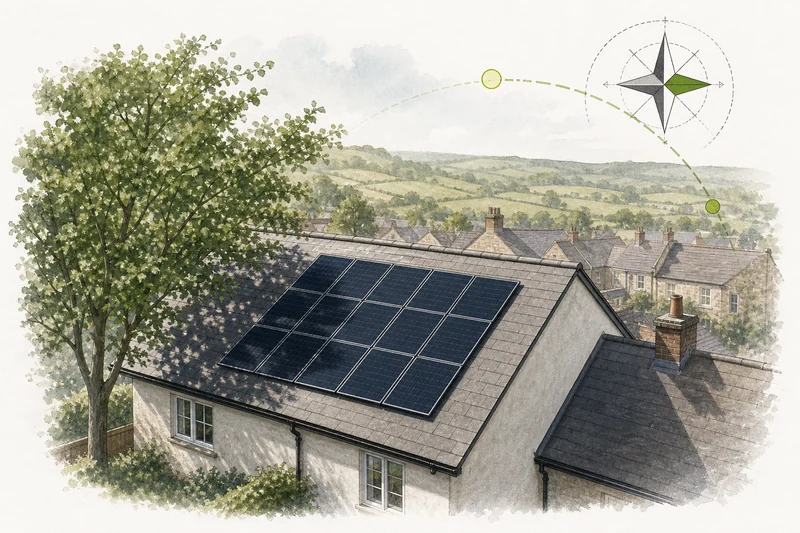
Orientation and pitch. South is best, but east and west are not written off: they spread generation across the morning and afternoon rather than concentrating it at midday, and on a farm with a long working day that can suit the demand better than a south-facing array does.
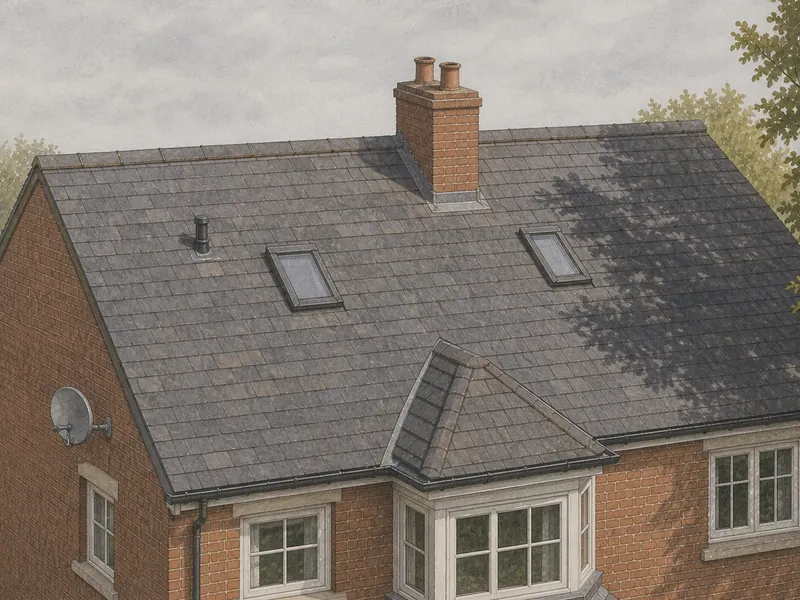
Structural condition. This is the one that stops most farm projects. The building has to carry the additional load, and on older agricultural buildings the purlins, the fixings and the covering are frequently the limiting factor rather than the frame. Asbestos cement roofing is a separate problem again and changes the job entirely. A structural assessment comes before a quotation, not after it.
Remaining life of the covering. If the roof needs replacing inside the array’s working life, replace it first. Removing and reinstating an array is a cost that does not appear in any initial quotation.
Land rather than buildings. Ground-mounted solar in the curtilage of a non-domestic building is permitted development on very tight terms: one installation only, no more than 4 metres high, not within 5 metres of the curtilage boundary, and a panel surface area not exceeding 9 square metres with no array dimension over 3 metres. Nine square metres is a very small array. Anything of a useful size on the ground needs planning permission, and that is a different conversation.
Source: GPDO 2015, Schedule 2, Part 14, Class K, paragraph K.1. Checked 19 August 2026. https://www.legislation.gov.uk/uksi/2015/596/schedule/2/part/14
Before any of that matters the roof has to be a candidate, and a good-looking one often is not. The screening tests are set out in the four things that decide whether a barn roof can take solar.
Your load profile decides the value
Here is the part that almost no installer page leads with, and it is the part that decides whether the system is worth building.
Electricity you generate and use yourself displaces electricity you would have bought. Electricity you generate and export earns you whatever your export tariff pays, which is a different and generally much smaller number. So the value of a farm solar array is set by the proportion of its output you consume on site, and that proportion is set by when your farm uses power, not by how much it uses in total.
Farm demand is unusual because it is driven by the work rather than by occupancy.
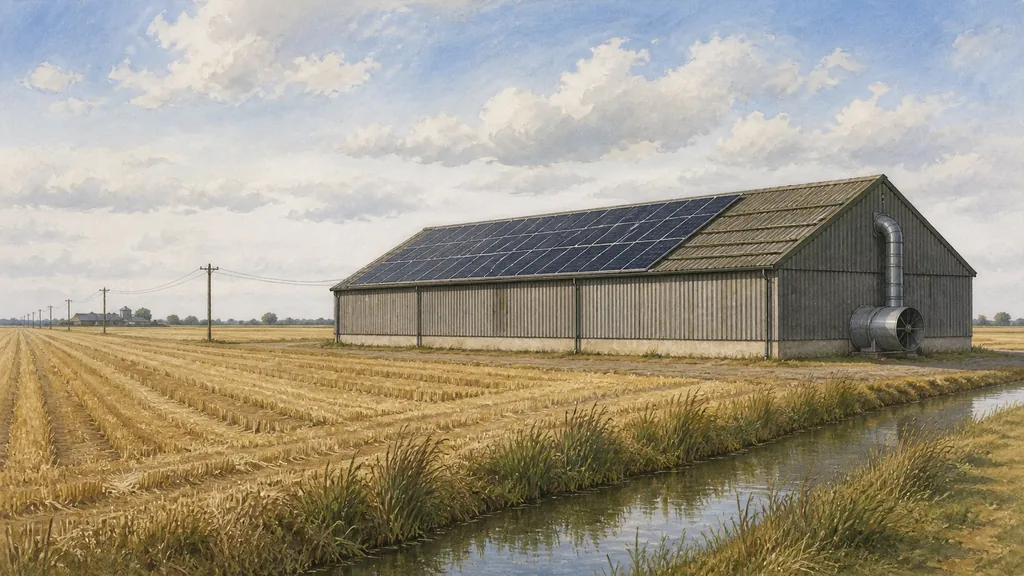
Grain drying is the most favourable pattern in arable farming and the most seasonal. A drying floor or continuous-flow drier is a very large load falling into a few weeks in late summer, exactly when generation peaks. For the other forty-something weeks of the year, the same array is generating into whatever the yard and the workshop happen to be using.
Refrigeration and chilling is the opposite: modest but continuous, day and night, all year. Cold stores, bulk milk tanks and vegetable chilling give a genuine base load, and a base load is what makes on-site generation reliably useful rather than seasonally useful.
Milking falls into two hard peaks a day. Where those peaks sit relative to daylight matters, and it differs between conventional twice-a-day parlours and robotic systems, which spread demand across the whole day.
Irrigation draws hardest in the brightest, driest conditions, which sounds like a perfect match and is only a partial one. Pumping is intermittent, weather-driven and concentrated into part of the season. It is worth measuring rather than assuming.
Workshops, grain stores, let units and the farmhouse each have their own pattern, and often their own meter and their own bill payer. Generation on a building whose electricity somebody else pays for is worth very little to you until that is resolved.
Three-phase supply. Much farm plant assumes it. Whether you have it, what capacity it has, and where on the holding it terminates will constrain the size of anything you install and what it costs to connect it.
The practical instruction is short: get half-hourly consumption data for the relevant meters before anyone designs a system. If a proposal is built on an annual kWh total rather than a demand profile, it is a guess wearing a spreadsheet.
Where daytime demand genuinely cannot absorb the output, storage is the next question rather than a larger array: /solutions/battery-storage/
This is the question that decides the whole investment, so it is worked through enterprise by enterprise in which farms solar actually suits. On an arable holding the drying load is the specific case worth testing: see whether the grain drier makes the case.
What drives the cost
You will find a great many pounds-per-kilowatt figures for farm solar online. We are not adding to them, and we would treat the ones you find with caution: they are almost all published by companies selling installations, and a cost figure is only meaningful against a specific building on a specific date.
What we will tell you is which variables actually move the number, so that when a quotation arrives you can interrogate it.
- System size, and whether it was set by the roof or by your demand profile.
- Structural work. Strengthening, purlin work, fixings, and whether the covering needs replacing or dealing with first.
- Mounting and access. Roof height, span, and whether the building can be worked on safely without disrupting the operation.
- Electrical work. Distance from the array to the point of connection, the condition and capacity of the existing installation, and whether a supply upgrade is involved.
- Network operator works. Anything the DNO requires as a condition of the connection offer, which is not known until that offer exists.
- Permissions. The prior approval application described below has a fee and a timescale attached to it.
- What is excluded. Scaffolding, asbestos handling, roof replacement and DNO charges are the four things most often outside a headline price.
Solar economics in general, including payback, are dealt with separately: /insights/solar/solar-panel-costs-savings-payback/
For what the arithmetic looks like once cost and self-consumption are put together, including a holding where the answer is that solar does not pay, see what farm solar actually pays back.
Grid connection, the practical blocker
Connecting generation is a separate permission from planning, and it is not granted by your energy supplier. It comes from your distribution network operator, the company that owns the wires onto the holding.
Which procedure applies depends on size. A generator with a capacity of less than 3.68 kW per phase falls under Engineering Recommendation G98. Above that, EREC G99 applies. Anything of a scale worth installing on a farm is on the G99 route, which is an application with conditions and forms to be satisfied before commissioning rather than a notification after the fact.
Compliance is the responsibility of the customer, who is quite often, but not always, the owner of the generation. Owners are required to make sure that generation equipment purchased and installed on their premises complies with the law. A competent installer will handle the submission in practice, but the obligation is yours: ask who is making it, and get written confirmation that it was made.
Source: Energy Networks Association, “Connecting generation to the electricity networks”. Checked 19 August 2026. https://www.energynetworks.org/industry/connecting-to-the-networks/connecting-generation-to-the-electricity-networks
Three things follow from this, and they are the reason connection is the blocker rather than the formality.
The offer sets the design, not the other way round. Connection cost, any reinforcement works, and any limit placed on how much you may export are decided by the network operator against your specific site. Until the offer exists, none of them is known. We are not going to publish a typical cost or a typical timescale, because we have no primary source for either and the ones in circulation are not evidence.
The sequence matters more than the paperwork. On the G99 route the answer can change what is worth installing. Ordering equipment before the connection position is understood is the most expensive avoidable mistake in farm solar.
Find out who your operator is before anything else. Use the Energy Networks Association postcode tool, or call 105 free, which connects you to your local distribution network operator. https://www.energynetworks.org/customers/find-my-network-operator
The connection route, what the network operator can and cannot tell you in advance, and who pays for reinforcement are covered in why you should talk to the network operator before the installer. Whether the holding has three-phase, what capacity it carries and where it lands is dealt with in three-phase supply on a farm.
Planning permission for farm solar
Solar on an agricultural building is dealt with under the permitted development class for non-domestic premises, which is not the class that applies to houses.
Rooftop equipment can be permitted development provided it does not protrude more than 0.2 metres beyond the plane of a pitched roof, does not sit more than 1 metre above a flat roof, is not within 1 metre of the external edge of the roof, and is not on a scheduled monument, a listed building or a building in the curtilage of a listed building.
The step most often missed. Where rooftop solar PV on a non-domestic building is not microgeneration, the developer must apply to the local planning authority before beginning the development for a determination as to whether prior approval is required as to design or external appearance, and in particular the impact of glare on occupiers of neighbouring land. Microgeneration means a capacity to generate electricity not exceeding 50 kilowatts. Development must not begin before the authority notifies its determination or gives prior approval, or before 56 days have passed from receipt of the application without a decision.
Most farm-scale rooftop arrays exceed 50 kilowatts. On those, this application is a required first step, not an optional one.
Sources: GPDO 2015, Schedule 2, Part 14, Class J, paragraphs J.1, J.4(2) and J.4(9), checked 19 August 2026, https://www.legislation.gov.uk/uksi/2015/596/schedule/2/part/14; Energy Act 2004, section 82(6) and (8)(a), checked 19 August 2026, https://www.legislation.gov.uk/ukpga/2004/20/section/82
Ground-mounted solar of any useful size needs planning permission, and where the land is classified as best and most versatile, which means agricultural land classification grades 1 to 3a, its quality is a material consideration. Local planning authorities must consult Natural England on non-agricultural applications causing the loss, or likely cumulative loss, of 20 hectares or more of that land where it is not in an approved development plan. You can check the indicative classification of your own land on Defra’s Magic map.
Source: Natural England, “Guide to assessing development proposals on agricultural land”, sections 2, 4 and 7, updated 24 July 2026. Checked 19 August 2026. https://www.gov.uk/government/publications/agricultural-land-assess-proposals-for-development/guide-to-assessing-development-proposals-on-agricultural-land
The full national planning rules, including the changes taking effect on 27 August 2026, are set out here rather than restated on this page: /insights/planning-and-costs/
Where the building is let or tenanted there is a separate question about who may consent to the work and who receives the benefit: see who owns the roof and who pays the bill.
Grants, tax relief and export payments
Three separate things get run together in sales conversations. They are not the same and only one of them is a grant.
Grants. As at 19 August 2026, the government’s page listing funding currently open or opening soon for farmers, growers and land managers in England contains no open grant for solar photovoltaic systems. The scheme that did fund them, round 2 of the Improving Farm Productivity grant, offered between £15,000 and £100,000 for solar PV systems and is recorded on that page as closed to applications. If a quotation you are given assumes a capital grant, ask which scheme it is and check it against GOV.UK before you rely on it. Eco Connect cannot obtain a grant for anyone and does not act as a grant agent.
Source: GOV.UK, “Funding for farmers, growers and land managers”, last updated 5 August 2026. Checked 19 August 2026. https://www.gov.uk/guidance/funding-for-farmers
Tax relief. Expenditure on solar panels is treated as special rate expenditure under section 104A(1)(g) of the Capital Allowances Act 2001. That matters, because it changes which reliefs are available. Annual investment allowance covers most plant and machinery, and the AIA amount is £1 million per accounting period. Full expensing, which deducts 100 per cent in the year of purchase, is available only to companies and only on main rate plant and machinery, so it does not apply to solar panels; the 50 per cent first-year allowance is the special rate equivalent, and it too is available only to companies. A farm trading as a sole trader or a partnership cannot claim either of those two. This is a summary of published rules, not tax advice, and your accountant should confirm the position for your business before you count on it.
Sources: Capital Allowances Act 2001, section 104A(1)(g), checked 19 August 2026, https://www.legislation.gov.uk/ukpga/2001/2/section/104A; GOV.UK, “Claim capital allowances: Annual investment allowance” and “Full expensing and 50% first-year allowance”, checked 19 August 2026, https://www.gov.uk/capital-allowances/annual-investment-allowance and https://www.gov.uk/capital-allowances/full-expensing
Export payments. The Smart Export Guarantee requires certain licensed electricity suppliers to pay small-scale generators for low-carbon electricity exported to the grid. Solar PV installations up to 5 MW capacity in Great Britain are eligible, subject to the criteria. The rate, the contract length and the other terms are set by the supplier, not by government, and the only rule on the rate is that it must be above zero. Ofgem’s advice is to shop around. Treat any export figure in a quotation as an assumption about a tariff you have not yet signed.
Source: Ofgem, “Smart Export Guarantee (SEG)”. Checked 19 August 2026. https://www.ofgem.gov.uk/environmental-and-social-schemes/smart-export-guarantee-seg
The grant position changes and a good deal of published material is out of date. The live position across all four UK nations, with the government source for each, is kept in farm solar grants: what is actually open. Where storage is being considered alongside generation, how big a farm battery should be sets out the sizing method.
How we work, and what we do not do
Eco Connect is an independent consultancy. We assess, we advise, and we do not install. We hold no installer accreditation and we make no claim to any. Where work is appropriate, it is carried out by a vetted delivery partner, and the final technical advice and the quotation come from them rather than from us.
We are also clear about what we cannot do. We cannot tell you what your local planning authority will decide. We cannot tell you what your network operator will offer. We cannot obtain a grant, and we are not tax advisers. Each of those answers comes from the body that owns it, and each of them will give you one directly.
What we can do is establish whether a project is worth pursuing at all, in what order, and what you should have established before you spend anything. Sometimes that answer is that the roof needs replacing first, or that the demand is not there, or that the connection needs settling before anything else is decided. We would rather tell you that early than have you find it out from a quotation.
Next step
The useful first step is a site assessment: the buildings, the supply, the demand profile and the constraints, written down, before anyone designs anything or prices anything.
If the buildings in question are commercial units rather than agricultural ones, or a mix of both, solar on farm and commercial buildings covers the planning position that applies to each. And whatever the building, the sequencing question is worth reading early: buy solar in winter, fit it in spring explains why the long items should start before the roof work is booked.
Information and source control
Information correct as of: 19 August 2026.
Planning rules, grant schemes, tax reliefs and network connection requirements change. Every rule, scheme and threshold on this page is dated and linked to the legislation, government or regulator source it was taken from. Check the source before you rely on it.
Nothing on this page is planning, legal or tax advice.