The short answer
Four questions, in this order. What is the roof made of? Can the frame carry the extra weight? How do you safely get onto it? And what is happening inside the building underneath?
The first of those, cladding, stops more farm solar schemes than everything else combined, because a very large share of British agricultural buildings are roofed in asbestos cement.
Test one: what the roof is made of
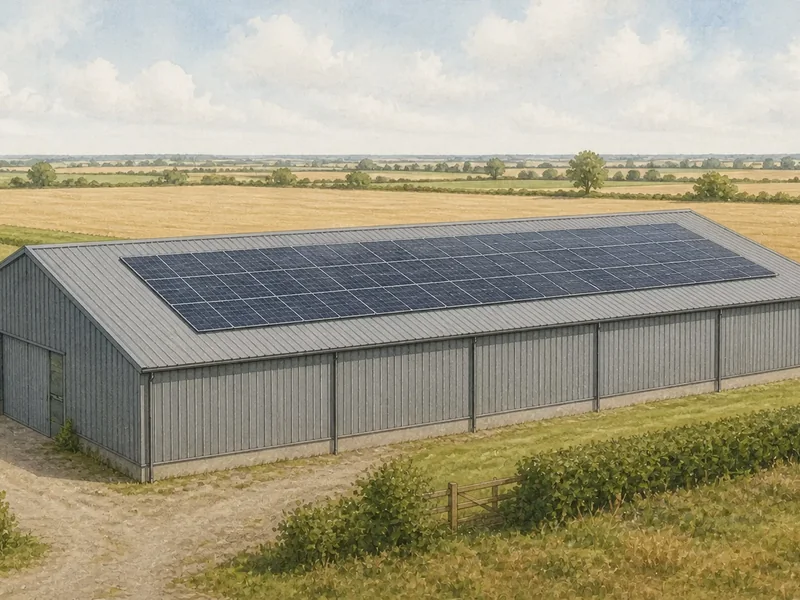
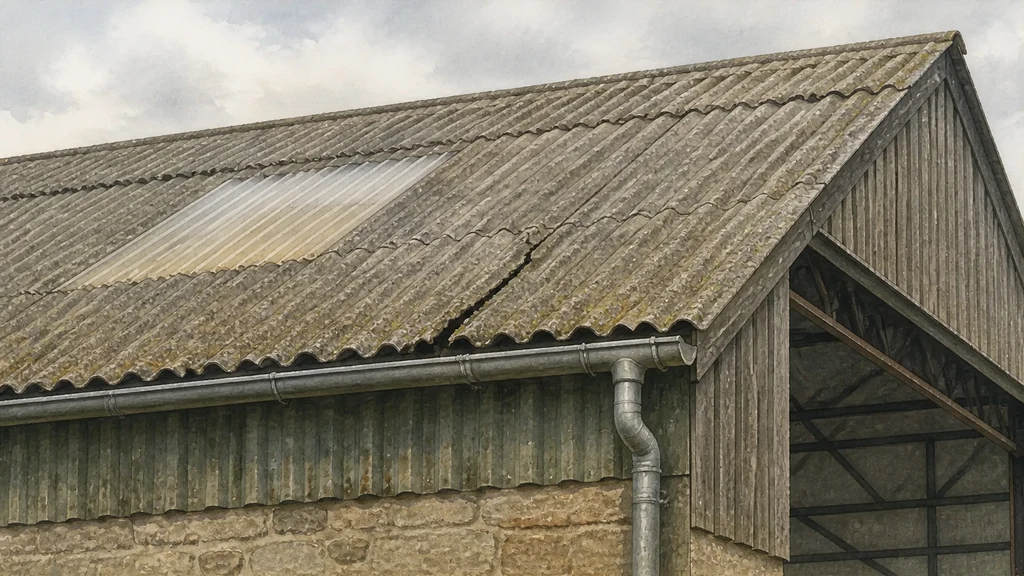
Most farm sheds built between roughly 1950 and 1999 are clad in profiled asbestos cement sheet. It was cheap, durable and everywhere.
For solar it is close to a full stop, for three reasons.
Panels cannot reliably be fixed to it. The sheet was never designed to carry a point load, and it becomes more brittle with age.
Drilling it is licensed work. Working on asbestos cement is regulated under the Control of Asbestos Regulations 2012. This is not a matter of taking care. It is a matter of using a licensed contractor, following a defined method, and consigning the waste as hazardous.
Over-sheeting usually does not solve it, because the additional dead load of a new sheet plus the array is generally more than the existing structure was designed for.
So the realistic route is full roof replacement: licensed removal, hazardous waste consignment and disposal, then a new sheet roof, and only then the array. This can double or triple the effective project cost, and it is the single most common reason a barn roof that looks perfect on aerial imagery is not a solar project.
What we could not tell you, and why
We could not find a single authoritative UK cost per square metre for agricultural asbestos removal and replacement. Every search returned contractor lead-generation sites with confident figures and no sourcing, and we are not prepared to repeat those as fact.
This has to be priced by a specialist contractor, site by site, before any payback figure is put in front of a client. Given it is potentially the largest single cost in the project, a payback calculated without it is not a payback.
The argument that changes the answer
There is a fair counter-point and it is worth putting properly.
If the roof needs replacing anyway within the appraisal period, and on a 1970s asbestos shed it very often does, then only the incremental cost belongs against the solar project. The re-roof was coming regardless. In that framing, solar is not burdened with the cost, it is what finances an overdue capital job and makes it happen sooner.
That is a genuinely different conversation from “solar costs three times what you were quoted”, and on a lot of holdings it is the more accurate one. The test is simple: would you be re-roofing this building in the next ten years anyway?
Test two: whether the structure can carry it
Solar adds roughly 10 to 15 kilograms per square metre. On a 1,000 square metre barn roof that is 10 to 15 tonnes of additional permanent load.
Agricultural portal frames, and purlins especially, were designed to minimum standards for the weight of the sheet plus a snow allowance. They were not designed with a decade of margin in hand.
A structural engineer’s report is essential and strengthening is common. Neither usually appears in an installer’s quotation. Budget £1,500 to £5,000 for the survey, and treat any strengthening as a separate line.
Two related points that get forgotten:
- Wind uplift. Panels change how wind behaves over the roof, particularly at edges and ridges. This is part of what the structural assessment is for.
- The building’s remaining life. Panels last 25 to 40 years. If the shed has fifteen years left in it, the appraisal horizon is fifteen years, not twenty-five. The correct horizon is the shorter of panel life and building life, and on older sheds the building is usually the binding constraint.
Test three: how you get onto it
Large-span agricultural roofs at height need substantial scaffolding and edge protection. It is a significant cost, and it is largely fixed regardless of how many panels go on, which is why it hurts small arrays disproportionately.
It also produces a finding that contradicts what most people assume.
Roof mounting is not the cheaper option. The only UK comparison we could find, sourced to Savills and Fisher German, puts ground mount at £700 to £750 per kW and rooftop at about £900 per kW. Roof mount costs more per kilowatt, because of scaffolding, working at height, roof surveys, sealing detail around every penetration, and the productivity penalty of working on a pitched profiled sheet rather than driving piles into a flat field.
Those figures are from 2019 and we could find no current replacement, so treat the direction as reliable and the size of the gap as unverified.
Roof mount still usually wins, but for different reasons than people think. It wins on planning, because it generally sits within permitted development rights. It wins on land opportunity cost, because the roof is not growing anything. And it wins on proximity to the load, which is what actually drives the economics. It does not win on cost per kilowatt.
Ground mount has its own offsetting costs, and they should be counted: planning permission at around £2,000 even for a small scheme, security fencing, longer cable runs, and the fact that it has been excluded from every recent grant round.
Test four: what is happening inside the building
The shed underneath the array affects the array.
Ammonia and dust from livestock ventilation degrade panels and corrode mounting hardware. This is well recognised in the farm press and poorly reflected in warranties. It raises cleaning frequency and it pushes degradation toward the top of the measured range.
That measured range is worth knowing, because it is not what the warranty says.
Manufacturers typically warrant 0.4 to 0.5% degradation a year. A survey of 3.3 million modules across more than 2,000 UK installations found 36.5% of modules showing thermal defects, with UK average degradation of 0.8 to 0.9% a year, and individual sites measured at 1.2% and 2.6%. Ten-year UK and Ireland field data puts England at 0.53 to 0.88% and Scotland at 1.05 to 1.16%.
Over 25 years the difference between 0.5% and 1.0% a year is roughly 6 to 7% of lifetime generation, which is enough to move a marginal project.
Two practical conclusions. Model a farm roof at 0.7 to 0.8% a year, not the warranted figure. And budget for periodic thermographic inspection, because a third of modules carrying defects is only a problem if nobody ever looks.
The costs that never make it into the quotation
Beyond the four tests, these are the items we most often see missing:
| Item | Realistic provision |
|---|---|
| Structural survey | £1,500 to £5,000 |
| Asbestos removal and re-roof | Site-specific, potentially project-defining |
| Scaffolding and access | Significant, and largely fixed regardless of array size |
| Network operator application | £500 to £600, plus whatever the answer costs |
| Maintenance, cleaning, monitoring | £8 to £15 per kWp a year on a farm roof |
| Insurance | £1 to £3 per kWp a year |
| Inverter replacement | 10 to 15% of original cost at year 12 to 15 |
| Lifting the array to repair the roof | Not negligible over 25 years |
| Removal and reinstatement at end of life | Almost never provided for |
On insurance, one specific check: confirm the existing farm policy covers the array itself, covers its temporary removal for roof repair, and covers business interruption arising from it. Do not assume the buildings policy extends automatically.
The screening sequence
Run these before anyone quotes for panels.
- Identify the cladding. If it is asbestos cement, get a specialist price for removal and replacement before going further, and establish whether the re-roof was due anyway.
- Commission a structural assessment for the additional 10 to 15 kg per square metre, including wind uplift.
- Establish the building’s remaining life and set the appraisal horizon to the shorter of building and panels.
- Get an access and scaffolding price, and understand that it does not scale down with a smaller array.
- Check what the building does. Livestock ventilation means higher cleaning, faster degradation and a thermographic inspection budget.
- Only then put a system size and a cost per kilowatt against it.
And run the grid question in parallel rather than afterwards, because it can change the answer just as decisively. See Talk to the network operator before you talk to an installer.
Figures current as at 1 September 2026. The roof-versus-ground cost comparison is from 2019 and no current UK replacement exists, so it is presented as direction rather than precision. No verifiable UK cost for agricultural asbestos removal is published, and we have said so rather than estimate one.