The short answer
As at 1 September 2026 there is no grant scheme open in England that funds on-farm solar PV or battery storage.
Wales has the best live offer in the UK, though it is a loan rather than a grant. Scotland’s most recent capital scheme expressly excluded solar. Northern Ireland’s scheme closed on 3 September 2026.
Anyone being told there is an English grant available should be asked which scheme, by name, and the answer checked against the government’s own funding page.
This page is about farms
If you are looking at solar for a house rather than a farm business, the position is different and is covered separately in Solar panel grants in the UK: what’s actually available in 2026. That guide deals with the domestic schemes, the VAT relief and export payments. This one deals with agricultural and other non-domestic support.
England
Nothing open that funds solar or storage
Checked against GOV.UK Funding for farmers, growers and land managers, updated 28 August 2026, and the Defra Farming Blog through 29 August 2026.
Open or rolling at the time of checking: the Sustainable Farming Incentive 2026 second window, Countryside Stewardship Higher Tier, Capital Grants 2026, the Farmer Collaboration Fund, Farming in Protected Landscapes, the animal health and poultry biosecurity reviews, and the woodland offers. None of them funds solar PV or battery storage.
What closed, and what it used to pay
| Scheme | Status | What it did |
|---|---|---|
| Improving Farm Productivity, Round 2 | Closed. No Round 3 announced | The only English route that funded solar. £15,000 to £100,000 at 25% of capital cost, minimum project £60,000 |
| Farming Equipment and Technology Fund 2026 | Closed 12 May 2026 | No solar or battery items in any theme |
| Rural England Prosperity Fund | Fund ended March 2026 | Some local authority schemes had funded on-farm energy |
The Improving Farm Productivity terms are worth keeping
If a successor round appears, it will most likely follow the same shape, and knowing the shape is useful when planning a project now.
Eligible: solar panels, battery storage, inverters, utility meters, electrical grid connections, power diverters, installation, and supply upgrades up to 10% of eligible costs.
Not eligible: ground-mounted solar arrays, and roof reinforcement.
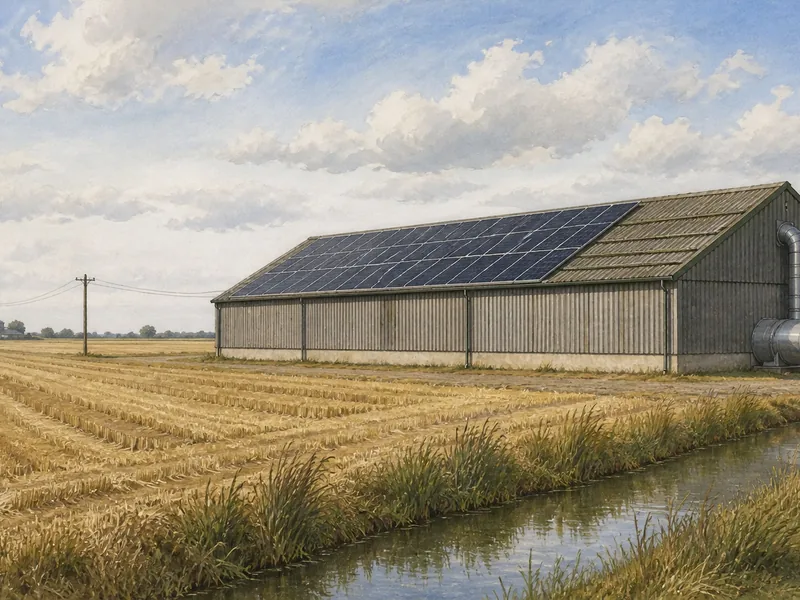
Conditions: the system had to be mainly for farm power and installed on farm buildings or irrigation reservoirs, not on a residential property. Export to the grid was permitted with no stated cap.
Two things follow from that list. Batteries were explicitly fundable alongside panels, which many people do not realise. And the exclusion of ground mount, alongside the exclusion of roof reinforcement, is a meaningful steer: it favoured rooftop systems on buildings that were already sound.
Wales
The Sustainable Agriculture Loan Scheme is open, launched 1 July 2026 as a one-year pilot.
- £25,001 to £1 million
- 3% fixed interest, up to fifteen years
- Renewable energy generation is an express eligible use
This is currently the strongest live support anywhere in the UK for a farm energy project. It is a loan, not a grant, so it does not reduce the capital cost. What it does is make the cost of capital considerably lower than commercial lending, which on a project with a seven-year payback materially improves the case.
One point we could not confirm: the scheme names renewable energy generation and energy efficiency as eligible uses. It does not specifically name storage. Worth confirming directly if a battery is central to the project.
Scotland
The Future Farm Investment Scheme is closed, having run from 14 July to 22 August 2025.
More importantly for planning purposes, it expressly excluded solar PV and renewables from eligible items. That drafting was unusually clear, and it is a reasonable indication of the direction of Scottish capital support rather than an oversight.
Northern Ireland
The Sustainable Farming Investment Scheme, Round 1 ran from 21 July to 3 September 2026, at a 40% grant rate with a maximum of £25,000 per business on investments between £3,000 and £62,500.
Whether solar was on the eligible item list we could not confirm. The published summaries describe equipment for fruit, vegetables, crops, grassland and livestock, and do not mention solar. The item list is a separate document. Anyone relying on this scheme needed to check that list directly.
The advice that follows from all of this
Build every appraisal so that it stands on its own without a grant, and treat any future round as upside.
That is not defeatism. It is the only sound basis for a capital decision at the moment, because the English position has been “nothing open” for long enough that waiting has a real cost, and because a project that only works with a 25% contribution was probably marginal anyway.
There is one exception worth flagging. A 25% capital contribution transforms a borderline case, and the Improving Farm Productivity scheme did fund batteries. If a holding sits in the seven to nine year payback band and a successor round is announced, it is worth being ready with a specification and quotations rather than starting from scratch. Watch the Defra Farming Blog, which signals openings several weeks ahead of the guidance pages.
Two things that are not grants but reduce the cost
Capital allowances. This is where advisers most often go wrong, so it is worth being precise.
All capital expenditure on solar panels is special-rate expenditure under the capital allowances rules (HMRC CA22335). Everything else follows from that.
| Allowance | Available for solar? |
|---|---|
| Annual Investment Allowance, 100% to £1m | Yes, and it should be allocated to special-rate expenditure first |
| Full expensing, 100% | No. Main rate only, and companies only |
| 50% first-year allowance, special rate | Yes, but companies only |
| New 40% first-year allowance from 1 January 2026 | No. Main rate only |
| Writing-down allowance if none of the above applies | 6% |
So a farm buying a tractor in 2026 gets a 40% first-year allowance. The same farm buying solar gets nothing in year one unless it has Annual Investment Allowance headroom, or it is a company using the 50% allowance.
One trap to check before advising anyone. A partnership that has a company as a member cannot claim the Annual Investment Allowance at all (HMRC PM163240). A mixed farming partnership therefore loses the AIA, cannot use full expensing or the new 40% allowance because those are main rate only, and cannot use the 50% special-rate allowance because that is companies only. It is left with a 6% writing-down allowance on the whole installation. On a large roof, how the asset is held can be worth a six-figure difference. This is a question for the business’s own accountant, and it is worth asking early.
Note also that grants reduce qualifying expenditure. Allowances are computed on cost net of any grant received, which is routinely forgotten when the two are modelled together.
Business rates. On-site renewable generation and storage plant is exempt from business rates in England until 31 March 2035, under regulations made in 2022. The exemption is technology-neutral and covers photovoltaics and storage. Two points of precision: it removes the value of the eligible plant from the rateable value, and it does not by itself prevent a standalone generating installation being assessed as a separate rateable property. Scotland has its own renewable energy generation relief on a sliding scale by rateable value.
What VAT does not do for a barn
The zero rate of VAT on energy-saving materials runs to 31 March 2027 and covers solar panels and, since February 2024, storage batteries. It applies to residential accommodation and buildings used solely for a relevant charitable purpose. Commercial and agricultural buildings are excluded.
In practice this matters less than it sounds, because a VAT-registered farm reclaims the input tax anyway. Where it does matter is the farmhouse and any mixed-use situation, where the cost has to be apportioned between the dwelling and the business.
Do not let a client be sold a “0% VAT” installation on a barn. It is not available, and a quotation that assumes it is understating the invoice.
The questions to put back
If a quotation you have been given refers to grant funding, four questions settle it quickly.
- Which scheme, by name? Not “there are grants available”. The name.
- Is it open, and where does it say so? The answer should be a GOV.UK page, not the installer’s own site.
- Does your holding qualify, and does this equipment qualify? Schemes have eligibility conditions that are often narrower than the headline.
- What does the quotation look like without it? If the answer is that the project no longer works, then the project does not work, and you have learned something valuable before signing rather than after.
Check the first two yourself. It takes about two minutes on the government’s own page, and it is the single highest-value piece of diligence available to you on a project of this size.
What we would say plainly
If a farm solar project only makes sense with funding that does not exist, it does not make sense.
That is an unwelcome thing to be told and it is the reason to have someone independent look at it. We do not install anything and we do not sell equipment, so there is no version of this answer that suits us better than another.
Where the numbers do work without a grant, and on the right building with the right load underneath it they can, that is a much more solid basis to proceed on than a scheme somebody half-remembered.
How to check this yourself
The position changes, sometimes at a few weeks’ notice. Two sources are worth more than any summary, including this one:
- GOV.UK Funding for farmers, growers and land managers, which carries the live status of every English scheme
- The Defra Farming Blog, which announces openings and closures earlier than the guidance pages
If a website tells you a scheme is open, check the name against the first of those. Several sites currently carry 2026 datelines while describing schemes that have closed, and at least one presents the Farming Investment Fund as a live route to solar funding. It is not. It was an umbrella term for a group of grants, every one of which is now closed.
Position checked 1 September 2026 against the sources named. Grant status changes at short notice and this page is reviewed monthly. Capital allowance and rating treatment are general information about how the rules work and are not tax advice on any particular business.