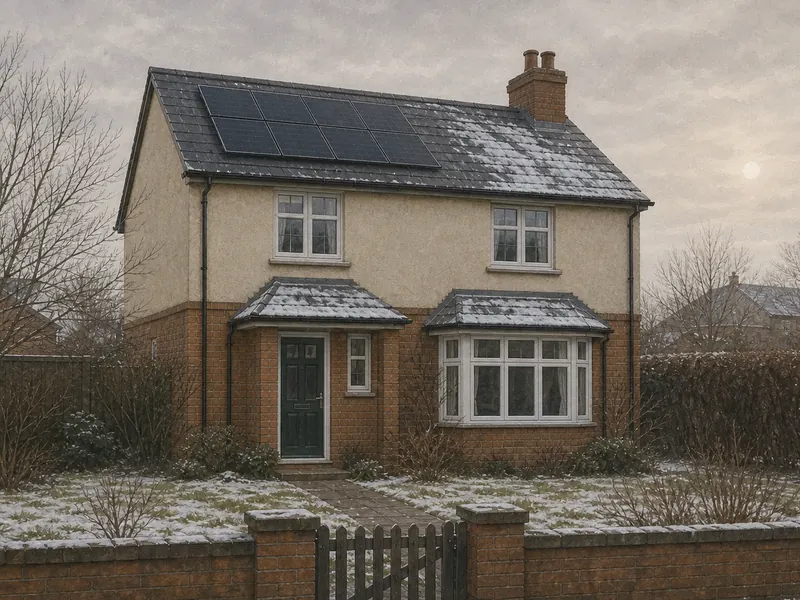
Enquiries about solar fall away as the clocks go back. That is understandable, and it is also the wrong way round.
A solar installation is not one job. It is a short physical job with a long administrative tail in front of it, and the tail is the part that decides when your system starts earning. Deal with the tail over the winter and the roof work becomes a couple of dry days in early spring, timed for the start of the generating year rather than the end of it.
This page is about that sequence. If your question is whether panels actually produce anything in a British winter, that is a different question and it is answered in do solar panels work on cloudy days and in winter.
What actually happens on the roof, and how long it takes
For a typical domestic installation, the work at height is measured in days. Scaffold goes up, panels and mounting go on, and the scaffold comes down. That is the part everyone pictures, and it is the smallest part of the calendar.
It is also the only part that genuinely wants decent weather. Nobody sensible fixes a roof mounting system in a gale, and a good installer will not try. But a couple of days of settled weather in February or March is not a difficult thing to find, and it is a great deal easier to book than a couple of days in June when every installer in the county is committed.
What happens before it, and how long that takes
Here is the sequence that runs ahead of the roof, and roughly what each part is waiting on.
| Step | What it is waiting on |
|---|---|
| Survey and design | An installer’s diary, and access to your roof and consumer unit |
| Quotations, plural | Your own time, and the discipline to get more than one |
| Roof condition check | Whether anything needs doing before panels are fixed down for 25 years |
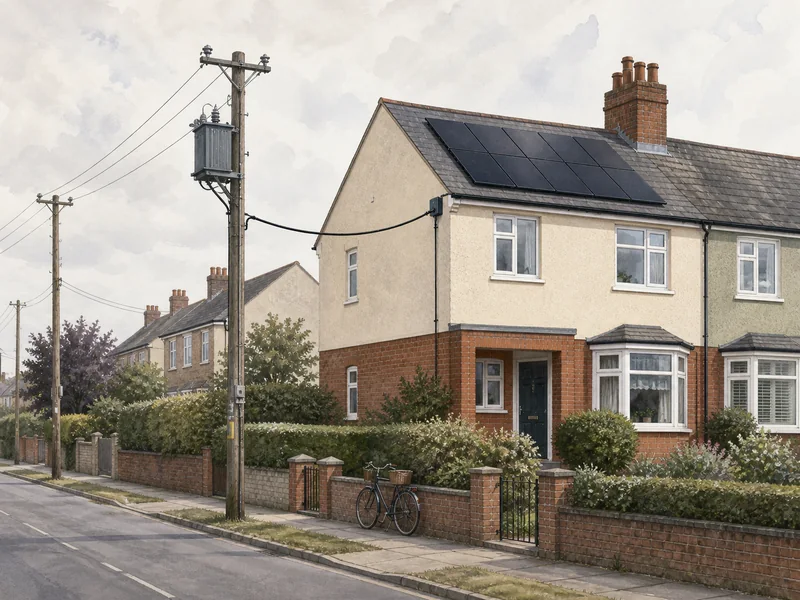
| Grid connection | The network operator, on their timescale, not yours |
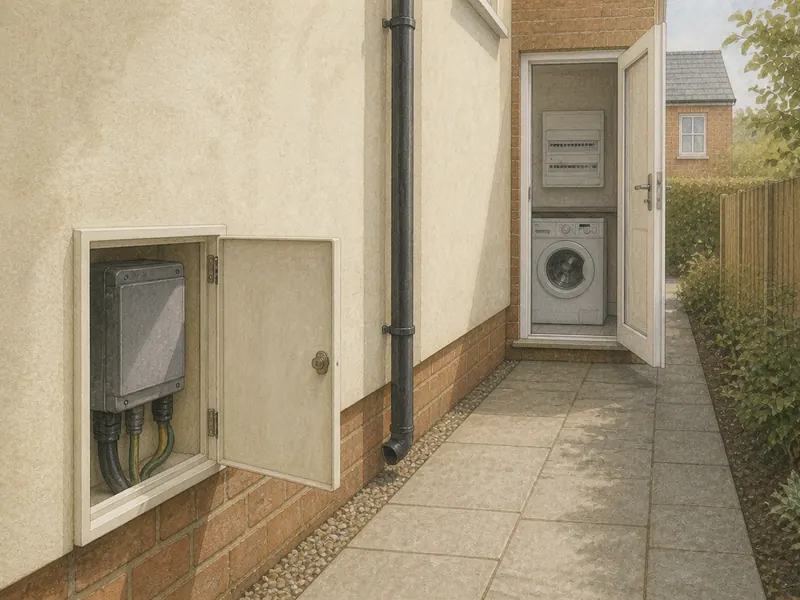
| Electrical work | Whether the existing consumer unit and earthing arrangement can carry it |
| Metering and export | Your supplier, after commissioning |
The one that most often sets the overall date is the grid connection, because it is the only one where you are waiting on a third party who has no particular reason to hurry.
The grid connection is the reason to start early
If the system qualifies under Engineering Recommendation G98, the installer can install and commission first and notify the network operator within 28 days. That is genuinely a notify-after process and it is quick.
Above that threshold, which in practice catches most arrays over about 3.68kW and many battery systems, you are into G99, and G99 is apply first and wait for written approval. Critically, G99 does not set a deadline for the network operator to respond. The duty runs the other way: your application has to give a commissioning date between ten working days and three months after you submit it.
Read that again, because it is the whole argument for winter. You are asked to name a commissioning date up to three months out, and the network operator is under no published obligation to come back to you by any particular day. A system you apply for in November can reasonably be commissioned in February. A system you apply for in April is not going to be generating for the best of the summer.
Switching on before approval is not an option worth considering. It breaches the connection terms, the network operator can require disconnection, and it counts against you at that address later. The detail of all this, including the export limitation route under G100, is set out in G98, G99 and G100 explained.
The roof itself is a winter question
If the roof needs attention in the next few years, it is dramatically cheaper to do it while the scaffold is already up and the panels are off. Once an array is fixed down, any later roof work means paying to remove it, store it, and refit it.
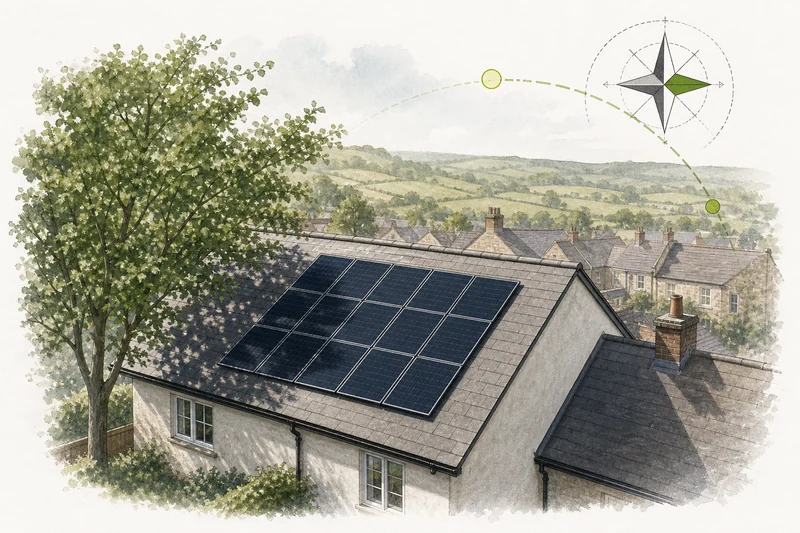
So the honest question at survey is not only “will the roof take the array”, but “what condition is this covering in, and what is its remaining life”. Is my roof suitable for solar panels covers what is being looked for. Winter is when roofers have capacity and when a problem found is a problem you still have time to fix.
What to actually do between now and spring
In rough order:
- Pull twelve months of electricity readings together. Not one bill. A year, ideally half-hourly data from your supplier if you have a smart meter, because when you use power decides the value of solar far more than how much you use. The readiness checklist lists what to gather.
- Get the survey done. Roof, structure, consumer unit, earthing, access. Cold weather does not stop any of it.
- Get more than one quotation, and compare them properly. What a solar quotation should itemise is the checklist for that. The cheapest number on the front page is not the comparison.
- Establish which connection route applies, and get the application in. This is the long pole. It is also the one nobody thinks about until it delays them.
- Deal with any roof work while the decision is still open.
- Book the installation for a spring slot, before installers’ diaries fill from March.
None of that requires anyone to stand on a roof in the rain.
For farms and commercial buildings, the case is stronger
Larger arrays are more likely to need a full G99 application, more likely to involve a supply that needs looking at, and much more likely to be competing for an installer’s attention in the busy months. The same logic applies with more force, and the seasonal work pattern helps: winter is when there is time to make decisions that spring will not leave room for.
If that is your situation, start with solar panels for farms in Lincolnshire, and read why you should talk to the network operator before the installer alongside it.
Where our knowledge ends
Eco Connect is an independent advisory business. We do not install solar, and we cannot tell you what a network operator will decide or how quickly they will decide it. Timescales vary by operator and by the state of the local network, and anyone who promises you a connection date on their own authority is promising something that is not theirs to give.
What we can do is work through the sequence with you, tell you which route your proposed system falls under, and make sure the long items are started first rather than discovered last.
Information and source control
Information correct as of: 3 September 2026.
Connection rules are set by the Energy Networks Association and administered by your regional network operator. The G98 and G99 positions described here are set out in full, with sources, in our grid connection guide. Check the source before you rely on it, including ours.
- Energy Networks Association, connecting generation: https://www.energynetworks.org/industry/connecting-to-the-networks/connecting-generation-to-the-electricity-networks