There is a genuinely good argument for solar on an arable farm, and it is not the one usually made.
The usual argument is that farm buildings have large roofs. That is true and it is close to irrelevant. Generation you cannot use is worth a fraction of generation you can, so the roof is not the constraint. The load underneath it is.
The coincidence worth understanding
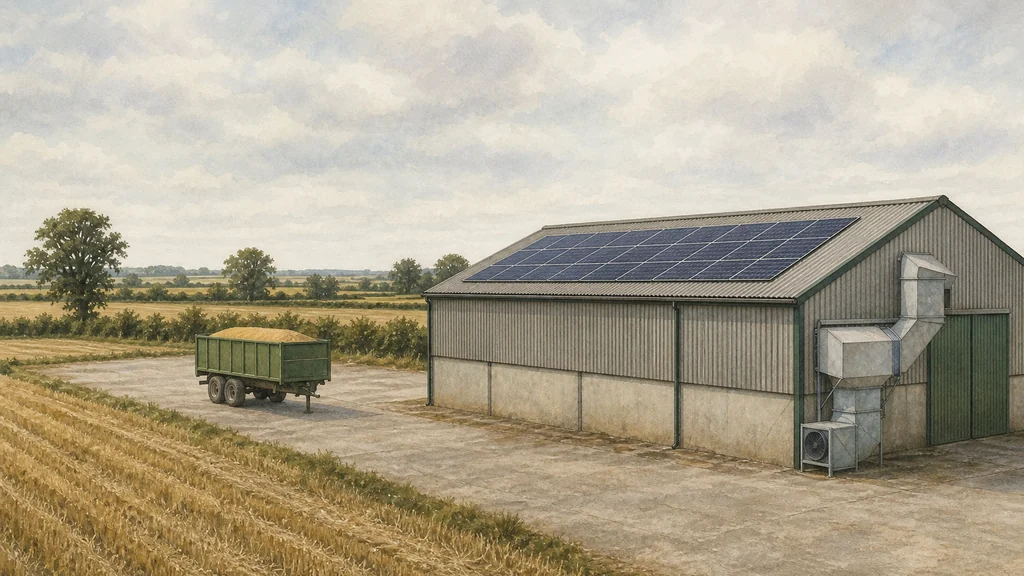
Grain drying is a heavy electrical load that lands in late summer, and late summer is when a solar array generates most.
That is the single most favourable coincidence in arable farming, and it is why an arable holding can make a better case for self-consumption than a much larger building with a flatter demand. A continuous-flow drier or a drying floor running through harvest is drawing hard in exactly the weeks a roof array is producing hard, in the middle of the day, when the array is at its peak.
If your drying is electric, that coincidence is real and it is worth quantifying properly.
And the reason it is not the whole answer
Harvest is a few weeks.
For the remaining forty-odd weeks of the year, the same array is generating into whatever else the holding uses, and on a lot of arable farms that is a much smaller load: some lighting, a workshop, a few motors, an office. Outside of harvest, an array sized to the drier is generating a great deal of electricity with nothing much underneath it.
So the honest framing is not “the drier makes solar work”. It is: the drier makes a case that has to survive the rest of the year.
Anyone showing you a payback figure derived from harvest-week conditions extended across twelve months is showing you a number that cannot happen.
What actually decides it
Four things, and they are all specific to your holding.
Is your drying electric at all? A great many driers run on gas or oil, with electricity used only for fans and augers. That is still a real load, but it is a different size of load, and it changes the answer substantially. This is the first thing to establish and it is often assumed rather than checked.
How many hours, across how many weeks? Drying demand is not a rate, it is a rate multiplied by hours. A wet harvest and a dry one produce very different totals from identical equipment. Two or three seasons of records tell you far more than a specification plate.
What does the rest of the year look like? Cold storage, workshop use, irrigation, let units, a farmhouse on the same supply, anything running overnight. This is where an array either finds a base load or does not.
What happens to the surplus? If your connection allows unrestricted export and you hold a Smart Export Guarantee contract, surplus generation still earns something, and the case survives a poor match reasonably well. If your connection is capped or zero-export, surplus is not exported at a lower value. It is not generated at all, because the inverter throttles output to stay within the limit. That changes the arithmetic considerably and it is decided by your network operator, not by your installer.
How to get a real answer rather than an estimate
You do not need modelling software. You need three things a competent installer should ask for, and many do not.
Half-hourly data from your supply. If the holding is on a half-hourly meter, that data exists and you are entitled to it. It shows demand across the day and across the year, which is the entire question. Nothing else substitutes for it.
Your drying records. Hours run per season, across as many seasons as you have, and which years were wet.
A clear statement of which buildings and which meters are in play. Farms frequently have more than one supply, and generation on one does not offset consumption on another. Establishing this at the start saves a great deal of expensive rework later.
If someone proposes a system size before asking for any of this, the size has come from the roof.
What we would tell you not to do
Do not size the array to the drying peak. Sizing to the largest load the holding ever sees produces a system that spends most of the year exporting or curtailing. The peak is a reason to look, not a specification.
Do not accept a single annual payback figure. A meaningful answer separates the harvest weeks from the rest of the year, because they behave completely differently. One blended number hides the whole question.
Do not assume the connection will allow it. On a farm the constraint is more often the grid connection than the roof, and an export limit imposed by your network operator can change what is worth installing. That is worth establishing before equipment is ordered.
Do not let a good harvest-week story carry a weak annual case. It is a compelling story. It is also three weeks long.
What Eco Connect does, and does not, do here
We assess and advise. We do not install anything, we do not sell equipment, and we do not price the work.
On a question like this that means looking at your actual consumption data, your actual drying records and your actual supply arrangement, and telling you whether the case holds up across a whole year rather than across a harvest. Where it does not, we say so, and that is the outcome that costs an installer a sale and costs us nothing.
Where work is appropriate, it is carried out by a delivery partner, and the technical design and the quotation come from them.
Information and source control
Information correct as at 1 September 2026.
This page deliberately contains no generation figures, payback periods or system sizes. Those are meaningful only against a specific roof, a specific demand pattern, a specific connection and a specific tariff, and a published average presented as an estimate is worse than no number at all.
Eco Connect is an independent advisory business. It does not carry out installations, holds no installer accreditation, and nothing on this page is planning, legal, tax or financial advice.